A word from Denise
Give that paste a whole night, and let it do the work while you rest. Then a quick scrub in the morning is usually all it takes.
Every tip here is checked against the sources listed at the bottom.
 By Denise. Checked on November 7, 2026 against the sources at the bottom of this page.
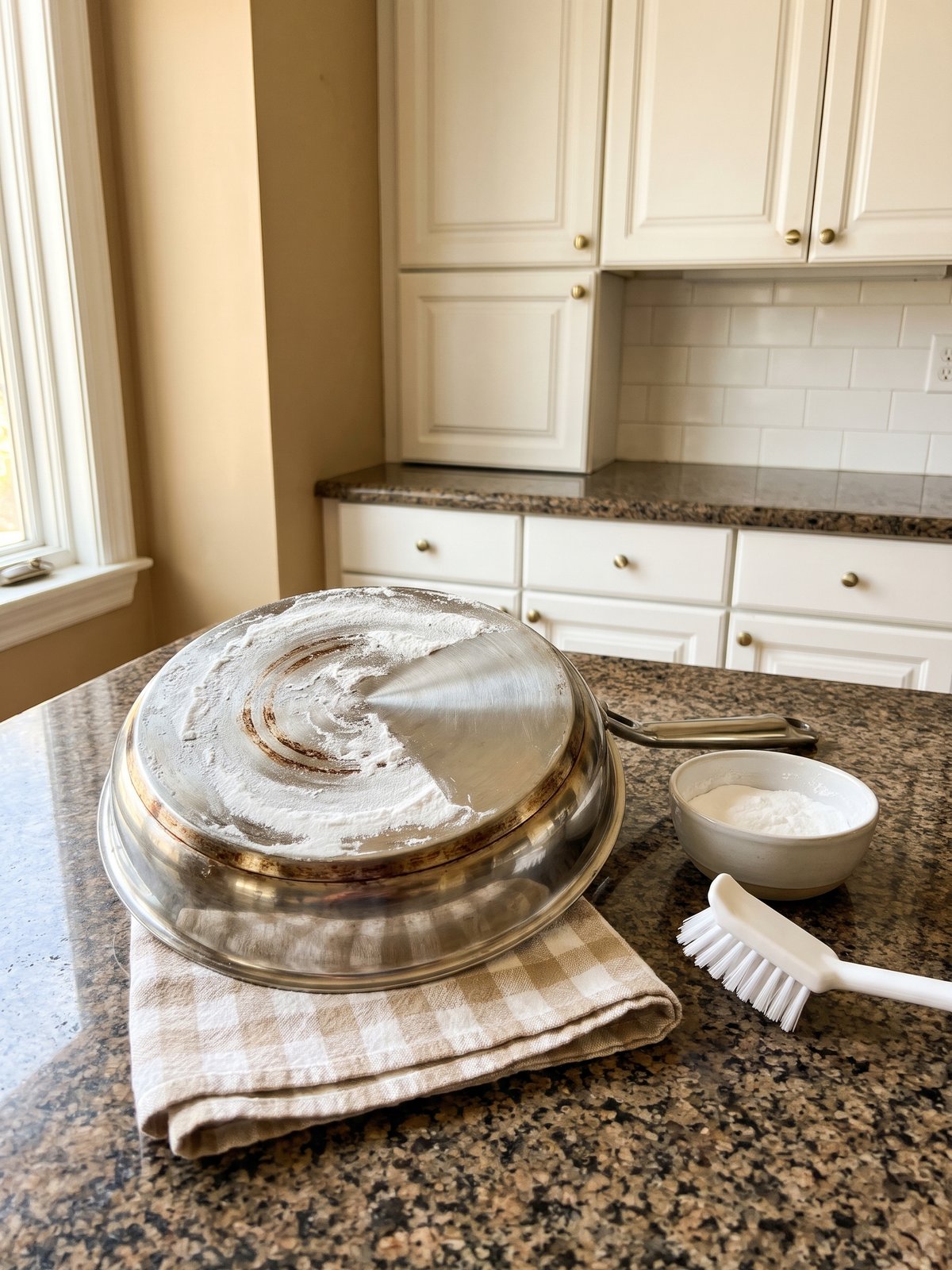
What works Turn the cool pan upside down and spread on a paste of 3 parts baking soda to 1 part water. Let it sit a few hours or overnight, then scrub with a nylon brush or scour sponge. On stainless steel, finish what is left with Bar Keepers Friend and rinse it off within a minute.
The metal decides what you can use, so check the maker’s care page if you are not sure.
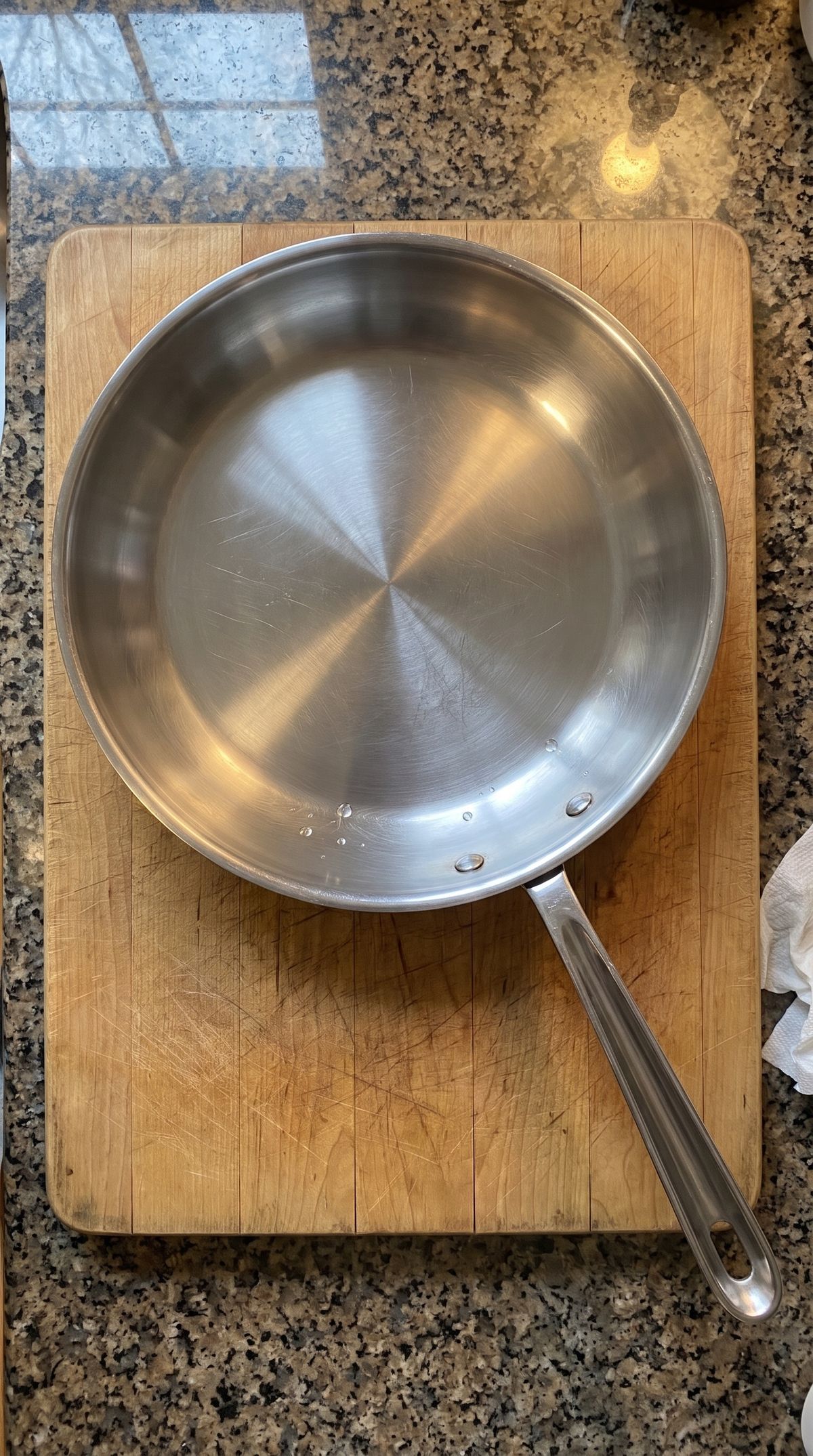
Wait until the pan is cool, as All-Clad advises before cleaning. Set it upside down on a towel in the sink, so the bottom faces up and the paste stays put.
Stir together 3 parts baking soda and 1 part water. That is Arm & Hammer’s ratio, and for a full pot bottom they suggest about 1 cup of baking soda and 1/3 cup of water.
Spread the paste generously over every brown and black spot. Then leave it alone for a few hours, or overnight.
Sprinkle on a little more baking soda, then scrub with a nylon brush or a scour sponge. That is how Arm & Hammer finishes the method. Skip steel wool, because All-Clad warns against steel wool and steel pads on its pans.
Rinse off the paste. If spots are left on a stainless steel bottom, wet the surface and sprinkle on a little Bar Keepers Friend. Rub gently with a wet sponge, then rinse it off within a minute, as the label says. Do not let it sit, and do not rub harder than you need to.
Rinse the whole pan with warm water and wipe it dry with a towel. The Bar Keepers Friend label says to rinse thoroughly and wipe dry.
Some bottoms have years of buildup, and some metals need a different touch. Here is what to do.
We may earn a small fee from these links. It never changes the picks or your price.
For the paste, which does most of the work. $1.79 at Target.com on 11/6/2026.
For the last spots on stainless. $2.69 at Target.com on 11/6/2026.
A non-scratch pad for the scrubbing step. $3.99 at Target.com on 11/6/2026.
The free Kitchen and Laundry Rescue Guide has the baking soda paste, which metals each cleaner must never touch, and the never-mix chart, ready to print.

That brown crust on the bottom of a pan is often oil that met high heat. Lodge, the cast iron maker, explains that oil heated hot enough changes from a wet liquid into a slick, hardened surface. That is the same change that seasons a cast iron skillet, and it is why plain soap slides right over it.
Baking soda is a mild alkali (the opposite of an acid, like vinegar), according to the American Cleaning Institute. Given a few hours, the paste gets to work on that layer so a nylon brush can lift it. Bar Keepers Friend works another way. It contains oxalic acid, and its label says to rinse it off within a minute.
Think of it like a sticky pot of rice. If you soak it first, the scrubbing is easy, and if you skip the soak, you fight it.
Most of us notice the bottoms of our pans at the worst time. The stove is clean, company is coming, and that pan is sitting there looking tired. It is easy to feel like the pan is ruined, but it almost never is.
A word from Denise
Give that paste a whole night, and let it do the work while you rest. Then a quick scrub in the morning is usually all it takes.
On stainless steel, yes. The label also lists copper and aluminum, with extra gentle rubbing on anodized aluminum. Keep it off nonstick, rinse it off within a minute, and never mix it with bleach.
Turn it upside down, keep a thin layer of water on it, sprinkle on baking soda and scour with a cut lemon half. That is Arm & Hammer’s method. Rinse and dry it right away, and never use bleach on copper.
No. Arm & Hammer says not to use its washing soda on aluminum. Use the baking soda paste instead.
Oil that meets high heat hardens into a slick layer, as Lodge explains, and the bottom of a pan sits right over the flame. The paste above loosens it.
I’m Denise, and I explain home fixes the way a friend would at your kitchen table. Every tip I share is written from the sources listed on its page and checked against them before it goes up.
Sources opened and checked on November 7, 2026.
Every claim on this page, the source behind it and what the check found. Kept open for anyone who wants to look under the hood.
| Claim | Source | What the check found |
|---|---|---|
| Paste of 3 parts baking soda to 1 part water; about 1 cup and 1/3 cup for a full pot bottom; a few hours or overnight | Source 1 | Matches the source (maker; rechecked November 7). |
| Baking soda paste method is for stainless steel or aluminum pans | Source 1 | Matches the source (maker; rechecked November 7). |
| Add more baking soda and scrub with a nylon brush or scour sponge | Source 1 | Matches the source (maker; rechecked November 7). |
| Let the pan cool before cleaning | Source 3 | Matches the source (maker; rechecked November 7). |
| No steel wool or steel pads on stainless | Source 3 | Matches the source (maker; rechecked November 7). |
| All-Clad names Bar Keepers Friend for stainless | Source 3 | Matches the source (maker; rechecked November 7). |
| BKF: wet surface, sprinkle, rub gently with wet sponge, rinse within a minute, wipe dry; do not let sit or rub harder than needed; test a hidden area | Source 2 | Matches the source (label via retailer; rechecked November 7). |
| BKF works on copper and aluminum; rub extra gently on anodized aluminum | Source 2 | Matches the source (label via retailer; rechecked November 7). |
| BKF: eye irritant, do not inhale dust, do not mix with bleach or ammonia, contains oxalic acid, flush eyes 15 to 20 minutes, wash hands | Source 2 | Matches the source (label via retailer; rechecked November 7). |
| Bleach plus an acid gives off chlorine gas; vinegar is an acid | Source 8 | Matches the source (official; rechecked November 7). |
| Lemon juice is an acid not to mix with bleach | Never-mix.html (NJ DOH row) | Matches the source. Via the built never-mix page |
| Copper bottom: upside down, thin layer of water, baking soda, scour with the flesh side of a cut lemon | Source 1 | Matches the source (maker; rechecked November 7). |
| Copper: cream copper cleaner; rinse with warm water and dry immediately; patina does not affect performance | Source 3 | Matches the source (maker; rechecked November 7). |
| Fine to let copper darken with age; never bleach, it will cause pitting | Source 4 | Matches the source (maker; rechecked November 7; “does not affect performance” is credited to All-Clad, not Mauviel). |
| Washing soda not on aluminum | Source 5 | Matches the source (maker; rechecked November 7). |
| Hard-anodized: warm soapy water, nylon pads or soft sponges, no steel wool | Source 3 | Matches the source (maker; rechecked November 7). |
| Cast iron: keep water, soap and acids away; BKF powder not on nonstick | Source 1 | Matches the source (rechecked November 7). |
| Oil heated hot enough changes from a wet liquid into a slick, hardened surface | Source 6 | Matches the source (maker; wording corrected 11/7 to match Lodge). |
| Baking soda is a mild alkali | Source 7 | Matches the source (rechecked November 7). |
| Stainless can take a washing soda paste (link to How to clean baked-on grease with washing soda (homemade “super soap”)) | Super-soap.html fact (Arm & Hammer pots and pans paste) | Matches the source (via built page). |
| Poison Help line, 1-800-222-1222; free and confidential, 24 hours a day, 7 days a week | Source 9 | Matches the source (HRSA Calling Poison Help page; one wording site-wide, November 7). |
| Prices: baking soda 1 lb $1.79; BKF 21 oz $2.69; Scotch-Brite Zero Scratch Scour Pads 4 ct $3.99 | Source 10, opened November 6, 2026 | Matches the source (dated, Target.com online). |