A word from Denise
When you want grease gone, reach for the washing soda, put your gloves on and let it sit the full thirty minutes. Patience does more scrubbing than your elbow ever will.
Every tip here is checked against the sources listed at the bottom.
 By Denise. Checked on November 6, 2026 against the sources at the bottom of this page.
What works Washing soda plus a little dish soap. Spray the mix on fresh or sticky grease and wipe. For the hard brown layer, spread a paste of 2 parts washing soda to 1 part water, wait 30 minutes, then scrub and rinse.
Washing soda is strong, and the maker is plain about where it does not belong. Go down this list before you start.
Washing soda is sold in the laundry aisle, usually as Arm & Hammer Super Washing Soda. It is not the same thing as baking soda. If you cannot find it, you can make it from baking soda in your oven (see “Making washing soda from baking soda” below).
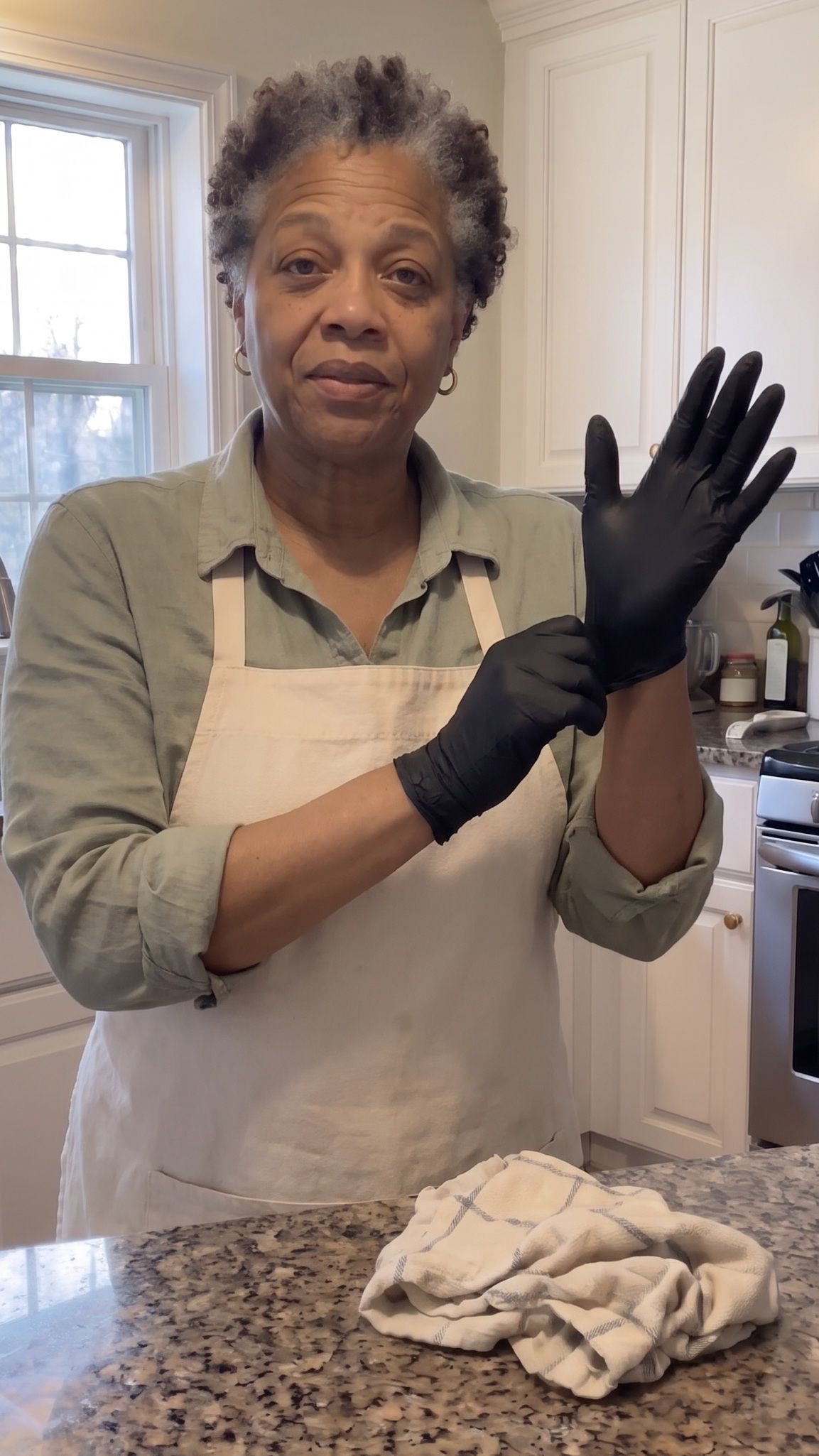
Put on your gloves. In a spray bottle, mix:
Close it, swirl gently until the powder dissolves, and label the bottle “Super Soap: washing soda, gloves on.”
This is a strong mix, about 8 times stronger than the maker’s everyday cleaning solution, so it is for real grease and not for wiping counters. If you want the gentle everyday version, use the maker’s ratio instead: 1/2 cup washing soda in a gallon of warm water.
What it looks like: cloudy at first, then mostly clear once it dissolves. A few grains on the bottom are fine; swirl again before each use.
Spray the greasy spot until it is wet, wait 5 minutes, then wipe with a non-scratch sponge. Rinse the surface well with plain water and dry it.
What it looks like when it is working: sticky grease turns slick and slides off under the sponge, and the sponge comes away yellow or brown. If the spot is a hard, shiny brown layer that does not move at all, that is baked-on grease, and Step 4 is for you.
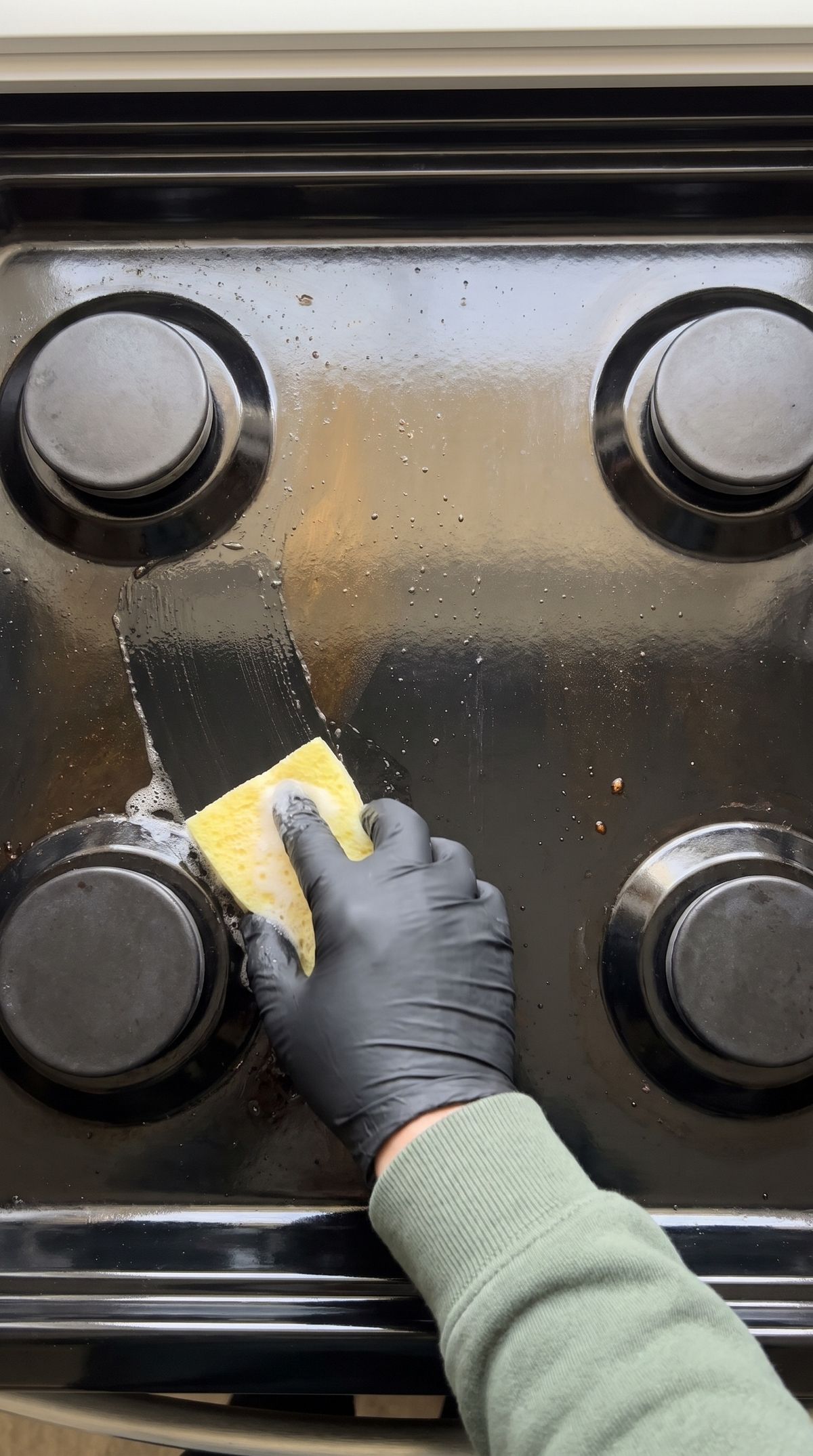
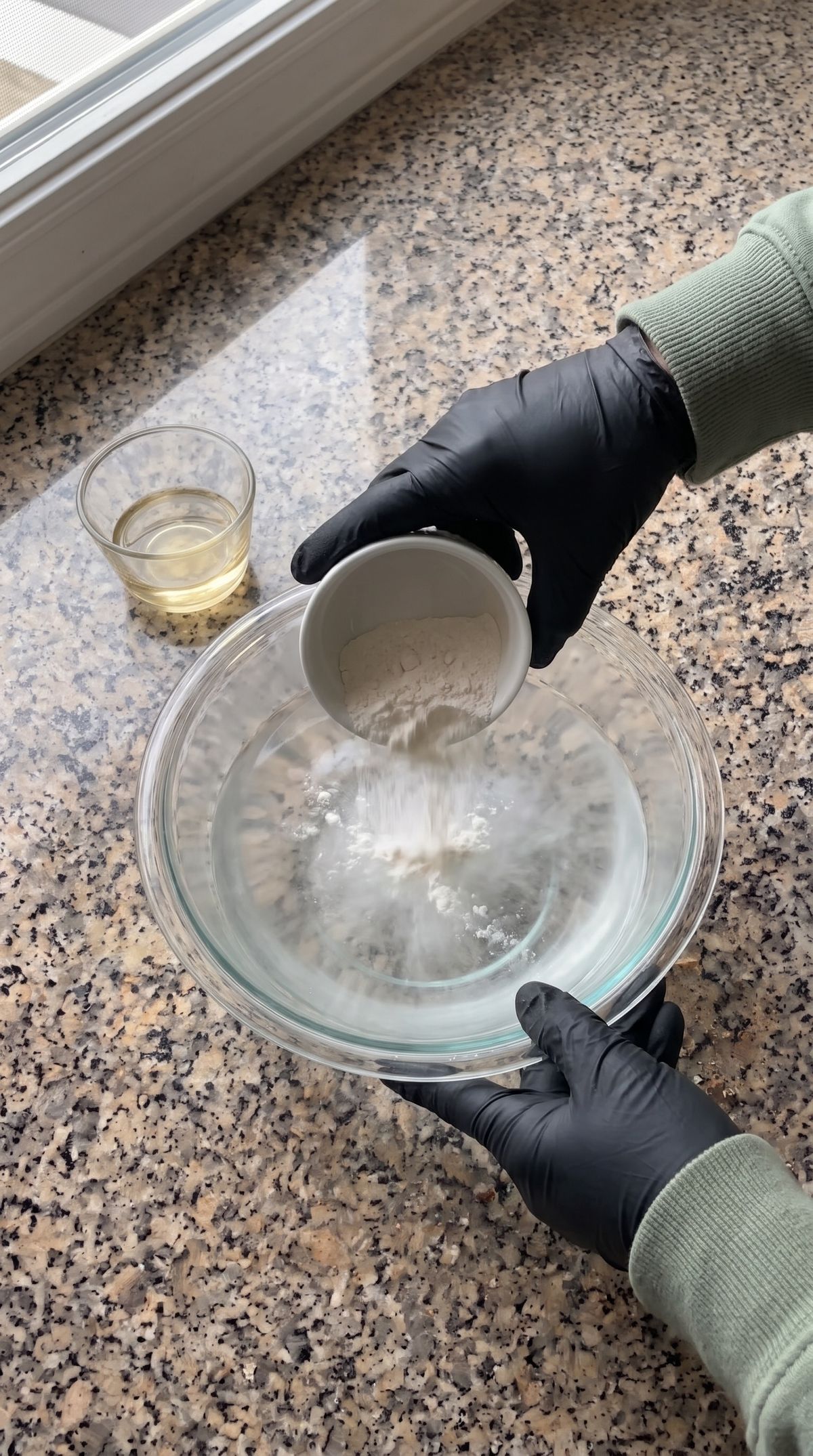
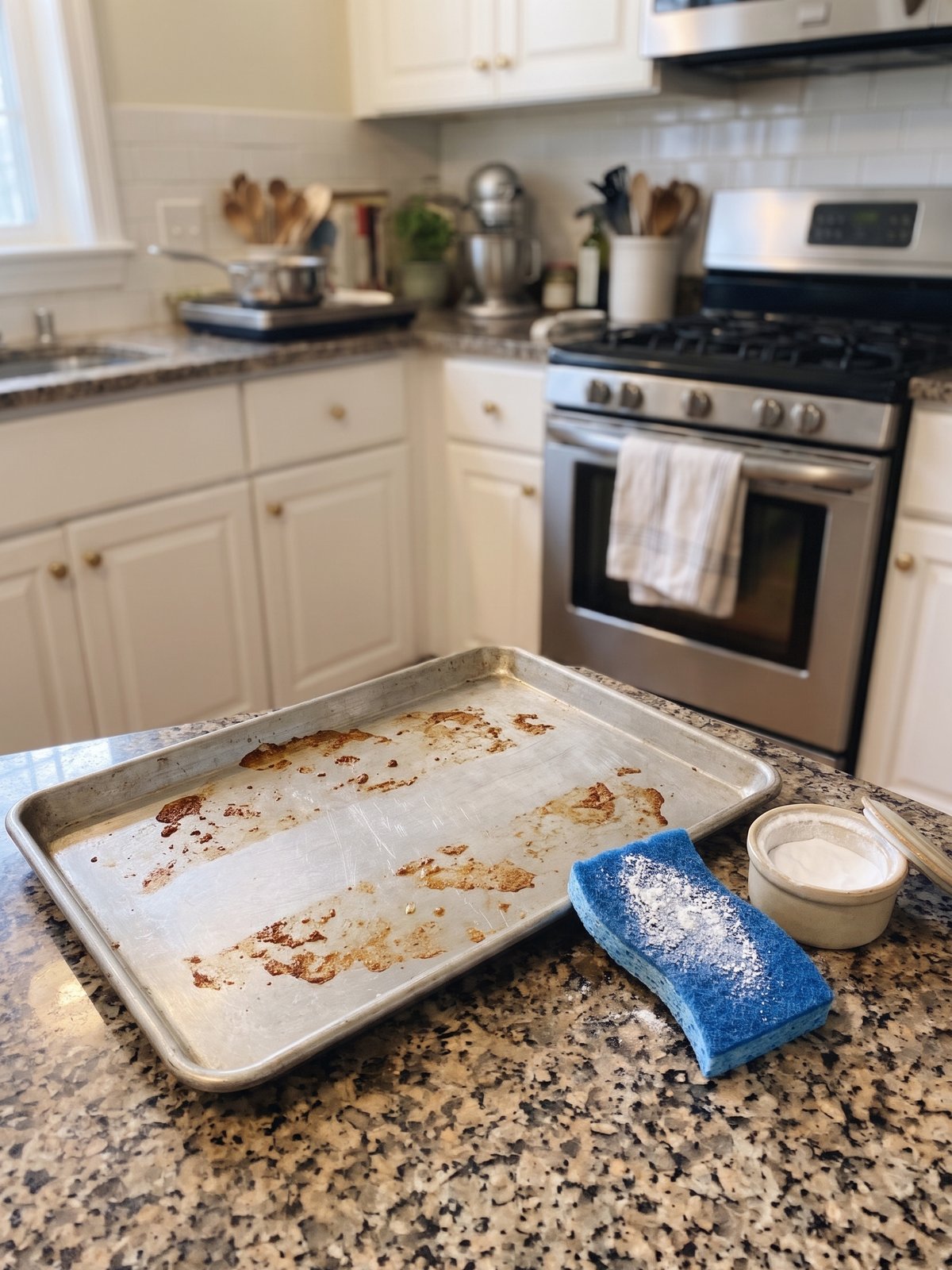
In a small bowl (not aluminum), stir 2 parts washing soda to 1 part water. For one pan, that is 1/2 cup washing soda and 1/4 cup water, plus a drop of dish soap. It should look like thick, wet sand. Spread it over the brown spots in a layer you cannot see through.
Optional swap: you can use 3% drugstore hydrogen peroxide in place of the water. Together, washing soda and peroxide are close to what oxygen bleach powder makes in water. We could not find any test showing it beats plain water on grease, so water is perfectly fine.
If you do use peroxide, mix it right before you use it and never put a lid on it.
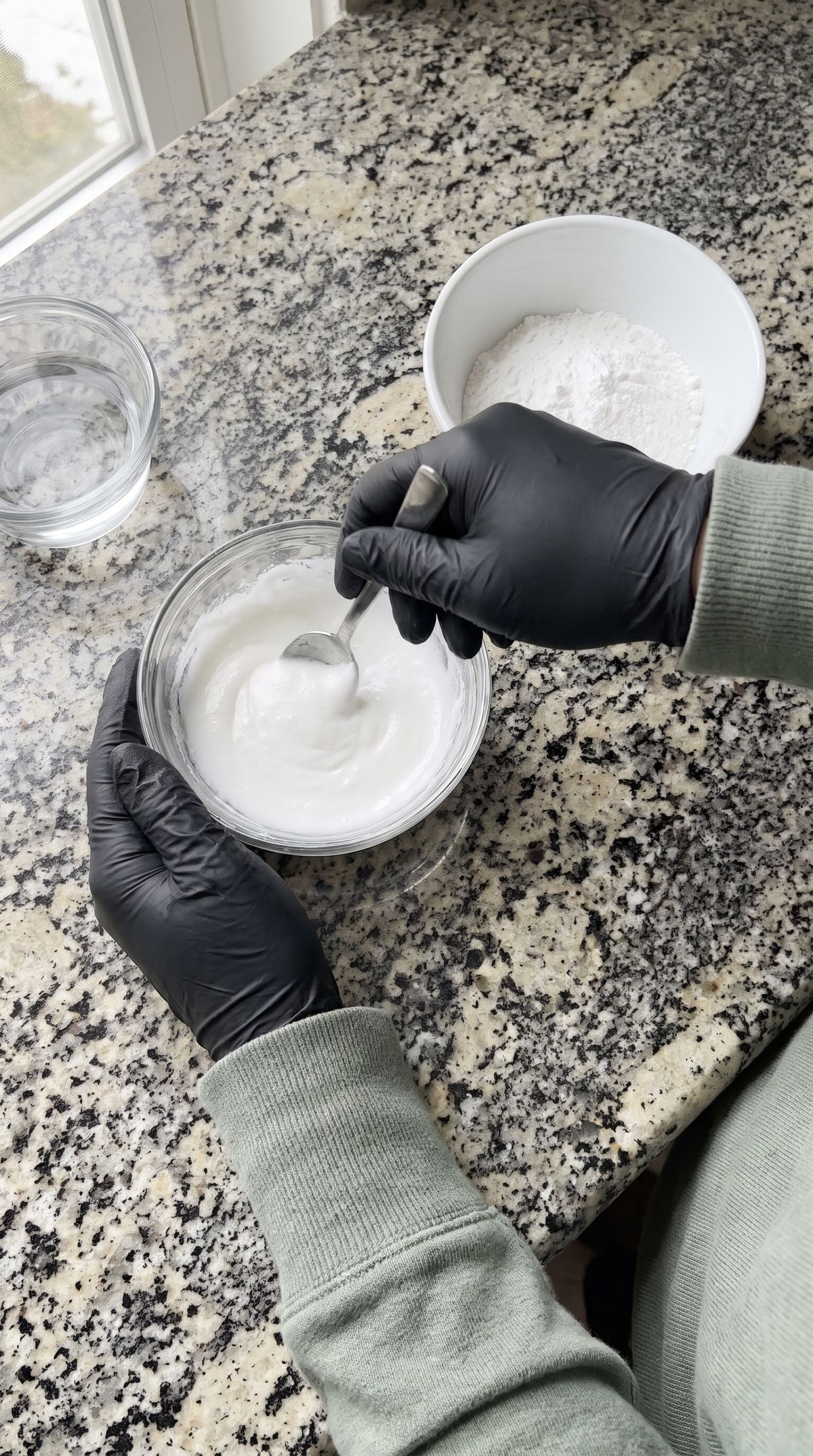
Leave the paste alone for 30 minutes. That is the maker’s stand time for pots and pans, and the wait is what does the work.
Scrub with a non-scratch sponge, rinse the pan thoroughly with plain water, then wash it with dish soap like normal.
What it looks like when it is working: the brown layer softens and starts coming away in flakes or smears as you scrub. If one spot will not budge, put on a second coat of paste and give it another 30 minutes. Very old, thick buildup often takes two rounds.
Heat changes baking soda (sodium bicarbonate) into washing soda (sodium carbonate), giving off water and carbon dioxide as it goes.
Is it cheaper to make it? Not really. On November 6, 2026 at Target.com, a 5 lb bag of baking soda was $4.99, and it makes about 50 ounces of washing soda (about 10 cents an ounce). A 55 oz box of washing soda was $5.49, which is also about 10 cents an ounce.
So making it is for when your store does not carry the box. It is not a way to save money.
If one of these sounds like your pan, here is what to do instead.
We may earn a small fee from these links. It never changes the picks or your price.
The one ingredient that makes this work. $5.49 at Target.com on 11/6/2026.
The label says to wear them. up&up Reusable Heavy Duty Latex Gloves were $3.39 at Target.com on 11/6/2026 (latex free pairs were $3.89).
Scrub hard without scratching stainless or enamel. A 3-pack of Scotch-Brite Delicate Clean Non-Scratch sponges was $3.49 at Target.com on 11/6/2026.
A 32 oz up&up spray bottle was $2.99 at Target.com on 11/6/2026, if you need one.
The free Kitchen and Laundry Rescue Guide has this recipe, the “never on” list and the never-mix chart, ready to print.
Dish soap is wonderful on fresh grease. One end of each soap molecule grabs onto oil and the other end grabs onto water, so the grease rinses away.
But grease that has been through the oven a few times is not really grease anymore. Heat links the oil together into a hard, heavy layer, the same way a cast iron pan gets its seasoning. Soap alone just slides across the top of that.
Washing soda is a fairly strong alkali (the opposite of an acid, like vinegar). An alkali can turn some of that hard fat into soap and loosen the rest. Now your dish soap has something to grab. That is the whole trick: you are not replacing your dish soap, you are giving it backup.
And honey, let me save you some fizz. Baking soda and vinegar bubble up so pretty that it feels like something is happening. What is really happening is that they use each other up, and you are left with mostly water, a little salt and some gas. It is a fine science fair volcano, but it is not a degreaser.
A word from Denise
When you want grease gone, reach for the washing soda, put your gloves on and let it sit the full thirty minutes. Patience does more scrubbing than your elbow ever will.
No. Baking soda is sodium bicarbonate. Washing soda is sodium carbonate, a much stronger alkali (its safety sheet lists a pH of 11.5). You can turn baking soda into washing soda with oven heat, but do not use washing soda in food.
For stainless steel and enamel, a paste of 2 parts washing soda to 1 part water, left 30 minutes and then scrubbed, is the maker’s own method. Aluminum, nonstick and cast iron need gentler care.
Arm & Hammer lists ovens, range tops and broiler pans, using 1/2 cup washing soda in a gallon of warm water, and dry washing soda on a damp sponge for stubborn spots. Rinse well afterward. Keep it off aluminum parts.
Not much. They cancel each other out. A chemistry lecturer at the University of Tasmania explains that the fizz is mostly for show, and that baking soda alone does more.
It is a degreaser, not a disinfectant. Washing soda is not labeled to kill germs, so this page makes no germ claims.

I’m Denise, and I explain home fixes the way a friend would at your kitchen table. Every tip I share is written from the sources listed on its page and checked against them before it goes up.
Sources opened and checked on November 6, 2026.
Every claim on this page, the source behind it and what the check found. Kept open for anyone who wants to look under the hood.
| Claim | Source | What the check found |
|---|---|---|
| Maker lists ovens, range tops, broiler pans (1/2 cup per gallon warm water), dry on damp sponge for stubborn soil, burners soak 30 min | Source 1 | Matches the source (maker). |
| Pots and pans paste: 2 parts washing soda to 1 part water, stand 30 minutes, scrub, rinse thoroughly, wash as usual | Source 1 | Matches the source (maker). |
| Super Soap spray: 1/2 cup washing soda in 2 cups warm water plus dish soap; about 8x the maker’s 1/2 cup per gallon | Source 1 ratio (1/2 cup per gallon); 16 cups vs 2 cups = 8x | Matches the source. It is strong, so gloves are a must. Dish soap 1 to 2 Tbsp is the original video’s choice; no source sets it |
| Do not use on aluminum cookware or surfaces; skip it on aluminum to keep the finish | Sources 1, 2, 3 | Matches the source (maker and label). |
| Not on fiberglass bathroom fixtures | Source 1 | Matches the source (maker). |
| Not on no-wax floors or treated wood; can remove finish on wooden decks | Source 3 (label); Source 2 | Matches the source. |
| Nonstick: no maker page found | Our search of maker pages | Matches the source. As stated (“I could not find”); caution, not a fact claim about damage |
| Cast iron seasoning is oil baked on by polymerization | Source 8 | Matches the source. “this mix is made to strip that kind of layer” is reasoning from Source 8, not a Lodge statement |
| Magnet sticks = not aluminum | Physics (aluminum is not magnetic); no page opened | Unsourced common fact; note some stainless also does not attract a magnet, which is why the copy says “if it does not stick, check the label” |
| Baking soda to washing soda: heat releases water and CO2; starts above 50°C, complete at 270°C; 350°F works if thin and given time | Source 4 | Matches the source. For the chemistry. The 30 to 60 minutes, thin layer and stir are our guidance, since no single official recipe gives a time |
| Weight check: ends about a third lighter; 16 oz becomes about 10 oz | Stoichiometry 106/168 = 63% | Matches the source (math). |
| Cost comparison: 5 lb baking soda $4.99 makes about 50 oz washing soda (10 cents/oz); washing soda 55 oz $5.49 (10 cents/oz) | Source 13 prices; 80 oz x 0.63 = 50.5 oz | Dated, Target.com online. Oven energy not counted |
| Store tightly sealed | Source 5 (“Keep containers tightly sealed”) | Matches the source. |
| Label the jar so nobody bakes with it; do not use in food | Label “Do not ingest” (Source 3) | Matches the source. |
| Surfactant one end oil, one end water | Source 6 | Matches the source. |
| Heated oil links into a hard heavy layer (polymerization), same as seasoning | Source 8 | Matches the source. |
| Washing soda is a fairly strong alkali; alkali turns fat into soap; washing soda only partly does this | Source 7 | Matches the source after a wording fix: “some of that fat”. |
| pH 11.5 | Source 5 (SDS, concentration not stated) | Matches the source. |
| Baking soda plus vinegar use each other up, leaving water, sodium acetate and CO2; fizz mostly for show; baking soda alone does more | Source 9 | Matches the source (3rd party, university chemist). |
| Vinegar cancels washing soda | Acid plus base; Source 5 (incompatible with acids, reacts with acids) | Matches the source. |
| Washing soda plus peroxide releases oxygen; pressure if sealed | Source 10 (percarbonate) | Matches the source. By close analogy |
| Eye irritant, harmful if swallowed, gloves; eyes 15 min; swallowed: rinse mouth, glass of water, do not induce vomiting, call physician | Source 3 (label); Source 1 | Matches the source (label). |
| Mixing cleaners can release dangerous gases | Source 11 | Matches the source (official). |
| Poison Help line, 1-800-222-1222; free and confidential, 24 hours a day, 7 days a week | Source 12 | Matches the source (HRSA Calling Poison Help page; one wording site-wide, November 7). |
| Wait 5 minutes on spray | Recipe choice | Recipe timing, not sourced |
| “What it looks like” cues: grease turns slick, sponge comes away yellow or brown; brown layer softens and flakes | General observation | Practical cue, unsourced; no “we tested” language is used |
| Old darkening can be baked in for good; smooth darkening is a looks problem | Not sourced | Unsourced; framed as “some of that darkening” |
| Not “way better than dish soap” | Wording choice; no source compares them head to head | Applied: copy says “giving it backup”, no comparison claim |
| Prices: washing soda $5.49 (55 oz); baking soda 5 lb $4.99; gloves $3.39 and $3.89; Scotch-Brite Delicate Clean 3 ct $3.49; up&up spray bottle 32 oz $2.99 | Source 13, opened November 6, 2026 | Dated, Target.com online; Walmart blocked by robot check |
| No germ claims | Site rule (no health claims) | Applied |
| Optional peroxide swap (the original video’s version); washing soda plus peroxide is close to oxygen bleach | Source 10 (percarbonate is sodium carbonate plus hydrogen peroxide) | Matches the source after a wording fix. No head-to-head test found, said so in the copy |