A word from Denise
So the next time something burns, take a breath, let the pan cool and give it a simmer. Cook over low and medium heat, as All-Clad advises, and that pan can stay slick for a good long while.
Every tip here is checked against the sources listed at the bottom.
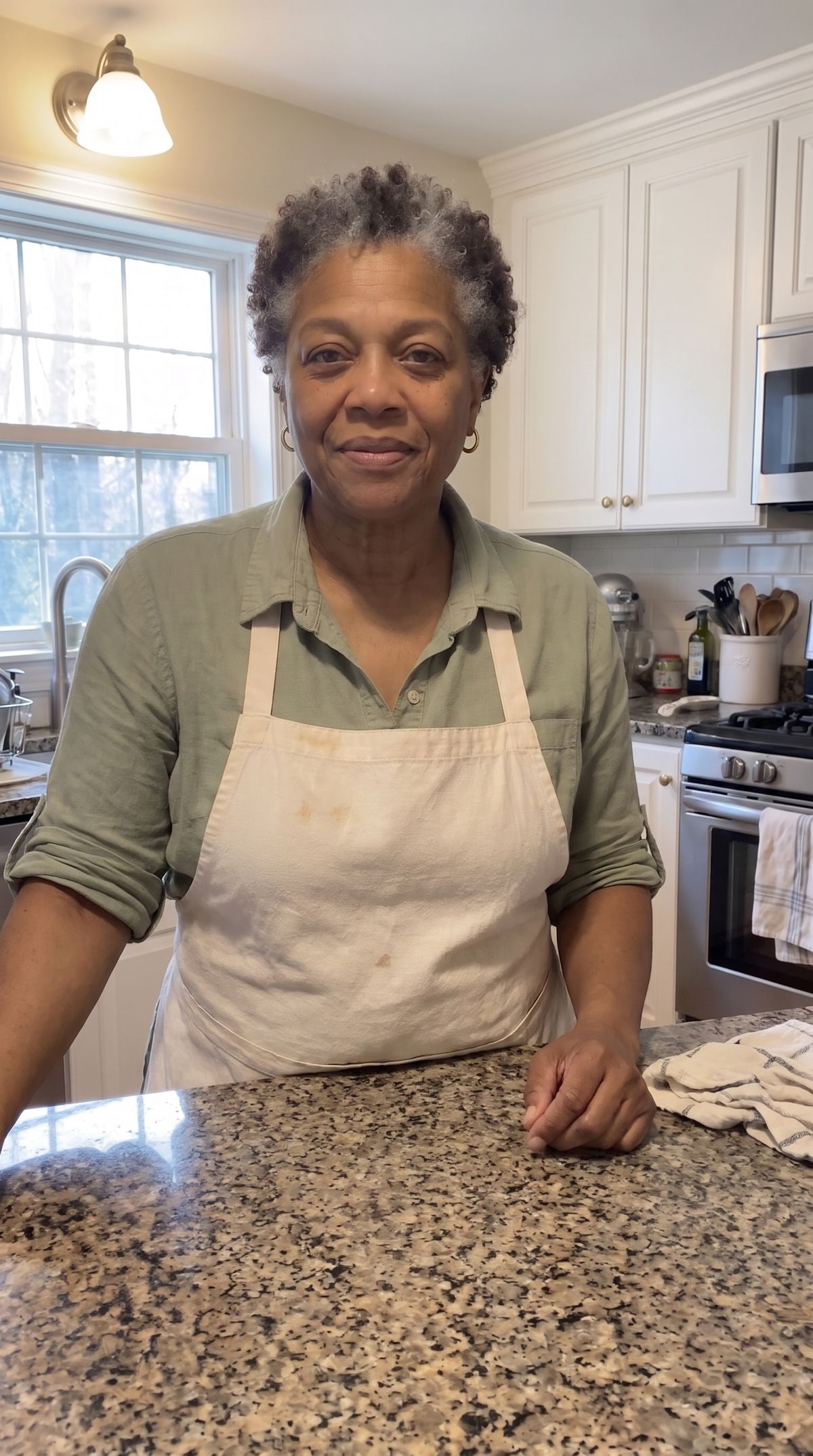 By Denise. Checked on November 7, 2026 against the sources at the bottom of this page.
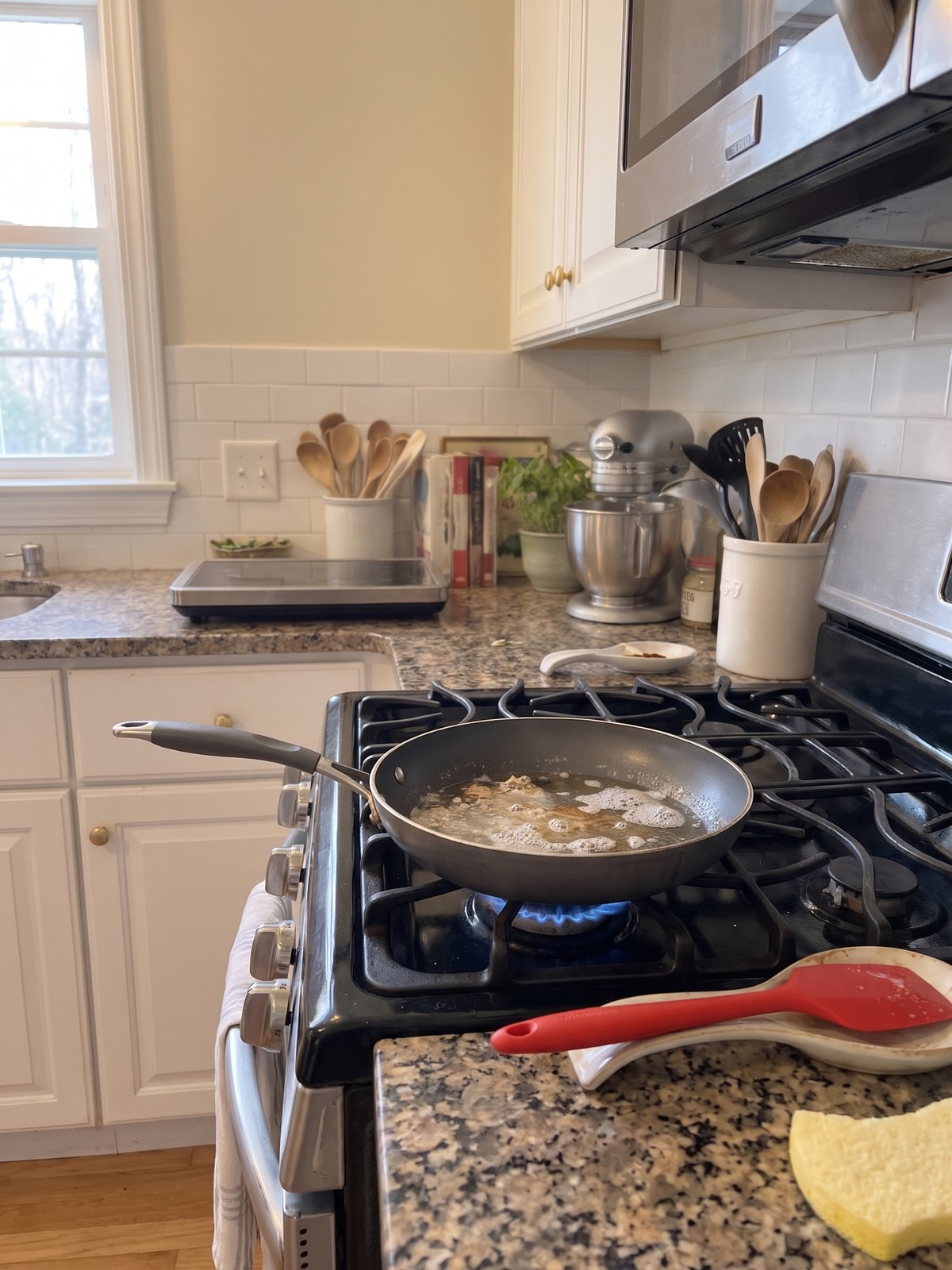
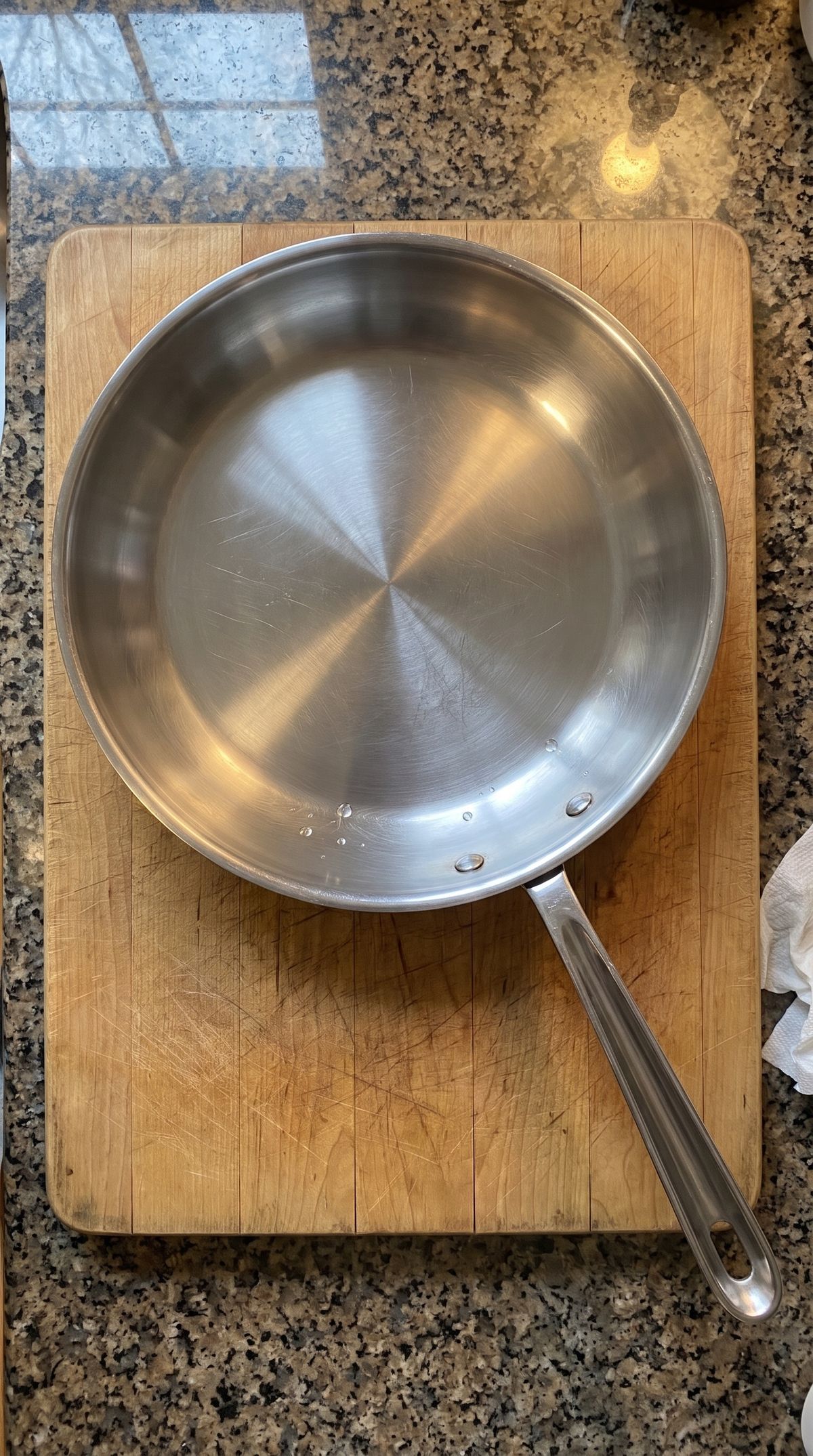
What works Let the pan cool all the way. Scrape out loose bits with a silicone spatula, cover the burnt spots with water and a little dish soap, and simmer over medium heat for 10 to 15 minutes. Let it cool a bit, then wipe with a soft sponge.
Take the pan off the heat and leave it on a cold burner until it is cool. Do not run it under the faucet while it is hot, because that sudden chill is what warps a pan.
Use a silicone, nylon or wooden spatula to push out anything that lifts easily. All-Clad recommends those tools, because metal utensils can scratch the coating.
Pour in enough water to cover every burnt spot, then add a little dish soap. That is the method GreenPan gives for a burnt nonstick pan.
Set the burner to medium and bring the water to a simmer, then keep it there for 10 to 15 minutes. Stay with the pan and never let it boil dry. All-Clad warns against overheating empty cookware.
What it looks like: small, gentle bubbles rather than a hard, rolling boil.
Turn off the heat and let the water cool until it is safe to touch. Pour it out, then use a soft sponge to wipe away the loosened bits, as GreenPan directs.
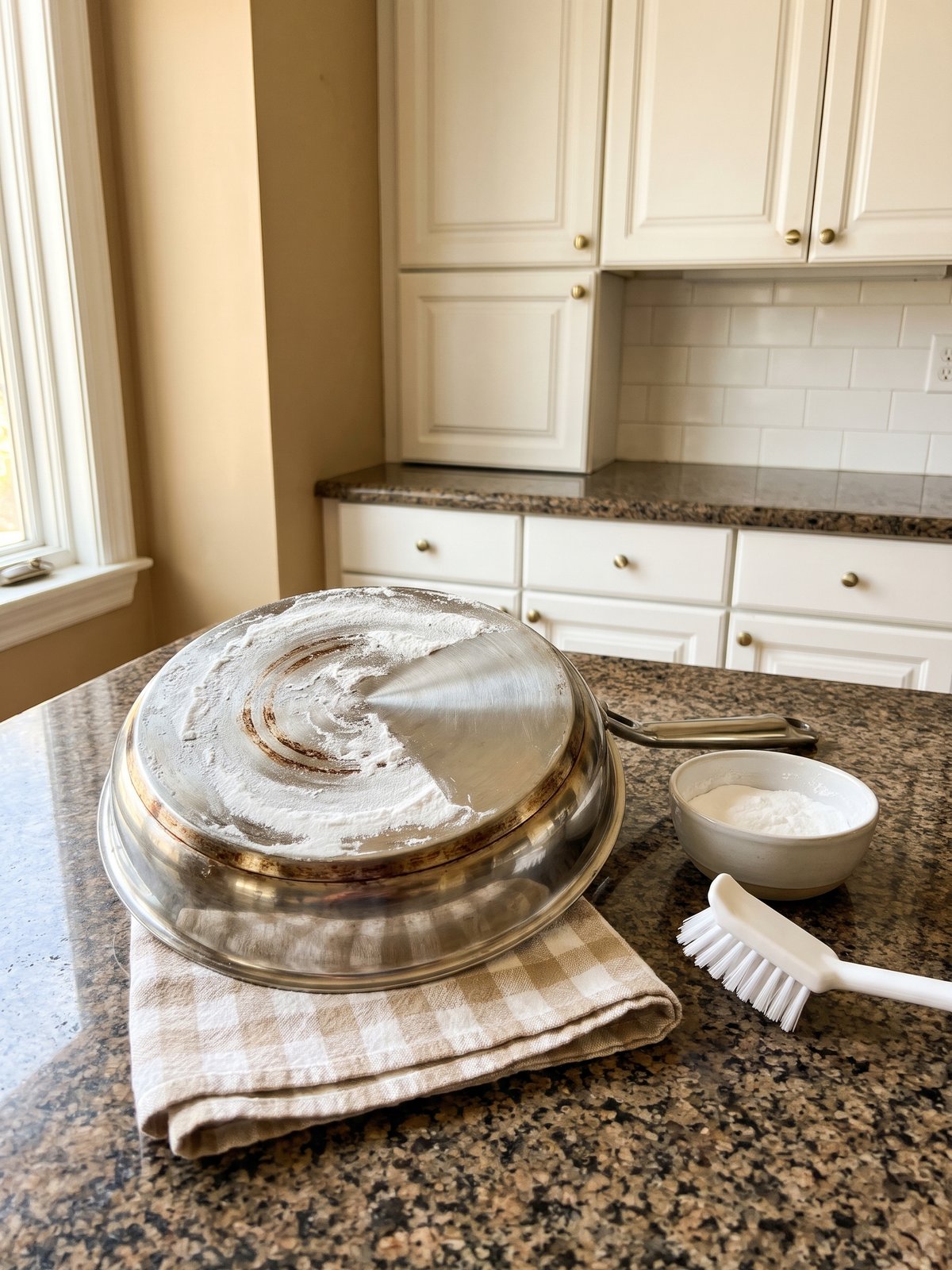
Mix baking soda with a few drops of water until you have a thick paste. Spread it on the stubborn spots and leave it 15 to 30 minutes, as GreenPan directs. Then wipe gently with a non-abrasive sponge or cloth, rinse and dry completely.
What it looks like: a thick paste that stays where you put it. If it runs, add a little more baking soda.
Wash the pan by hand in warm, soapy water, rinse it and dry it. All-Clad and Calphalon both recommend hand washing, even for pans that are labeled dishwasher safe.
Sometimes a nonstick pan still gives you trouble after a good cleaning. Here is what is usually going on.
We may earn a small fee from these links. It never changes the picks or your price.
For the paste, if your pan’s maker allows it. $1.79 at Target.com on 11/6/2026.
It scrapes without scratching the coating. Cook With Color Silicone Spatula was $2.99 at Target.com on 11/6/2026.
Soft enough for the coating, with a little more grip than a cloth. up&up Non-Scratch Scrub Multi-Surface Sponges were $3.39 to $5.59 at Target.com on 11/6/2026.
The free Kitchen and Laundry Rescue Guide has the cleaner-by-surface list and the never-mix chart, ready to print and tape inside a cabinet.

Here is what is happening in that pan. The coating is slick so food cannot grab hold, but the makers warn that metal utensils and steel wool can scratch it. Anything rough enough to scour burnt food off bare steel is too rough for nonstick.
So instead of force, this method uses water, heat and time to loosen the burnt layer. Dish soap helps because one end of each soap molecule loves water and the other loves oil and grease, as the American Cleaning Institute explains. The grease gets carried off in the water instead of staying stuck to the pan.
Baking soda is a mild alkali (the opposite of an acid, like vinegar). That is why some makers allow it as a gentle paste and others would rather you skip it.
Most of us learned to clean a pan by scrubbing harder. With nonstick, that instinct is the very thing that wears the pan out. It is a little like washing a good silk blouse: the gentle way is the one that keeps it.
A word from Denise
So the next time something burns, take a breath, let the pan cool and give it a simmer. Cook over low and medium heat, as All-Clad advises, and that pan can stay slick for a good long while.
It depends on the pan. GreenPan and Arm & Hammer give baking soda methods for nonstick, but Calphalon’s care sheet for its Classic Nonstick line says not to use baking soda. Check your pan’s care page first.
Some can, but makers lean toward hand washing. All-Clad says its nonstick is dishwasher safe but recommends hand washing, and it says its ceramic nonstick should not go in the dishwasher at all.
Often it is cooking spray buildup. Calphalon says aerosol sprays build up on its nonstick and are hard to remove, so cook with a little oil instead.
When the coating is flaking, or when burnt residue will not come off after a simmer and a paste. Made In says a coating that has started to break down will keep breaking down.
I’m Denise, and I explain home fixes the way a friend would at your kitchen table. Every tip I share is written from the sources listed on its page and checked against them before it goes up.
Sources opened and checked on November 7, 2026.
Every claim on this page, the source behind it and what the check found. Kept open for anyone who wants to look under the hood.
| Claim | Source | What the check found |
|---|---|---|
| Never immerse a hot pan in cold water; it causes irreparable warping | Source 1 | Matches the source (maker; rechecked November 7). |
| Let the pan cool completely before washing | Sources 1 and 2 | Matches the source (maker; rechecked November 7). |
| Plastic, nylon, silicone or wooden utensils; metal can scratch the coating | Source 2 | Matches the source (maker; rechecked November 7). |
| Cover burnt areas with water, add a bit of dish soap, simmer over medium 10 to 15 minutes, cool slightly, wipe loosened debris with a soft sponge | Source 3 | Matches the source (maker; rechecked November 7). |
| Baking soda with a few drops of water as a thick paste, 15 to 30 minutes, wipe with a non-abrasive sponge or cloth, rinse and dry | Source 3 | Matches the source (maker; rechecked November 7). |
| Calphalon Classic Nonstick: no baking soda, abrasive cleaners or pads, oven cleaners, bleach, floor or porcelain cleaners; voids warranty | Source 1 | Matches the source (maker, one product line; rechecked November 7). |
| Arm & Hammer nonstick methods: paste, or bring 1/2 cup water with 4 Tbsp baking soda just to a boil, cool, scrub gently | Source 5 | Matches the source (maker of baking soda, not of the pan; rechecked November 7). |
| All-Clad and Calphalon recommend hand washing even when dishwasher safe; All-Clad ceramic nonstick not for the dishwasher | Sources 1 and 2 | Matches the source (maker; rechecked November 7). |
| Aerosol sprays build up and are hard to remove (Calphalon); All-Clad does not recommend cooking spray | Sources 1 and 2 | Matches the source (maker; rechecked November 7). |
| All-Clad: no oven cleaners, steel wool, steel scouring pads, harsh detergents on nonstick | Source 2 | Matches the source (maker; rechecked November 7). |
| Cook over low and medium heat; do not overheat empty cookware | Source 2 | Matches the source (maker; rechecked November 7). |
| Once a coating starts to break down it keeps going; flaking; replace if residue stays after both methods | Source 4 | Matches the source (maker; rechecked November 7). |
| No washing soda and no Bar Keepers Friend powder on nonstick | No maker page we found allows washing soda on nonstick; Sources 1 and 2 rule out abrasive cleaners and harsh detergents | Stated as a caution |
| Baking soda and vinegar react; sodium acetate is an even weaker base than baking soda; use one at a time | Source 8 | Matches the source (opened November 7). |
| Surfactants: one end attracted to water, the other to oil and grease | Source 6 | Matches the source (rechecked November 7). |
| Baking soda is a mild alkali | Source 7 | Matches the source (rechecked November 7). |
| Poison Help line, 1-800-222-1222; free and confidential, 24 hours a day, 7 days a week | Source 9 | Matches the source (HRSA Calling Poison Help page; one wording site-wide, November 7). |
| Prices: baking soda 1 lb $1.79; silicone spatula $2.99; up&up non-scratch sponges $3.39 to $5.59 | Source 10, opened November 6, 2026 | Matches the source (dated, Target.com online). |