A word from Denise
So tie that bag on whenever the spray starts to weaken, and wipe the head dry after you shower.
Every tip here is checked against the sources listed at the bottom.
 By Denise. Checked on November 7, 2026 against the sources at the bottom of this page.
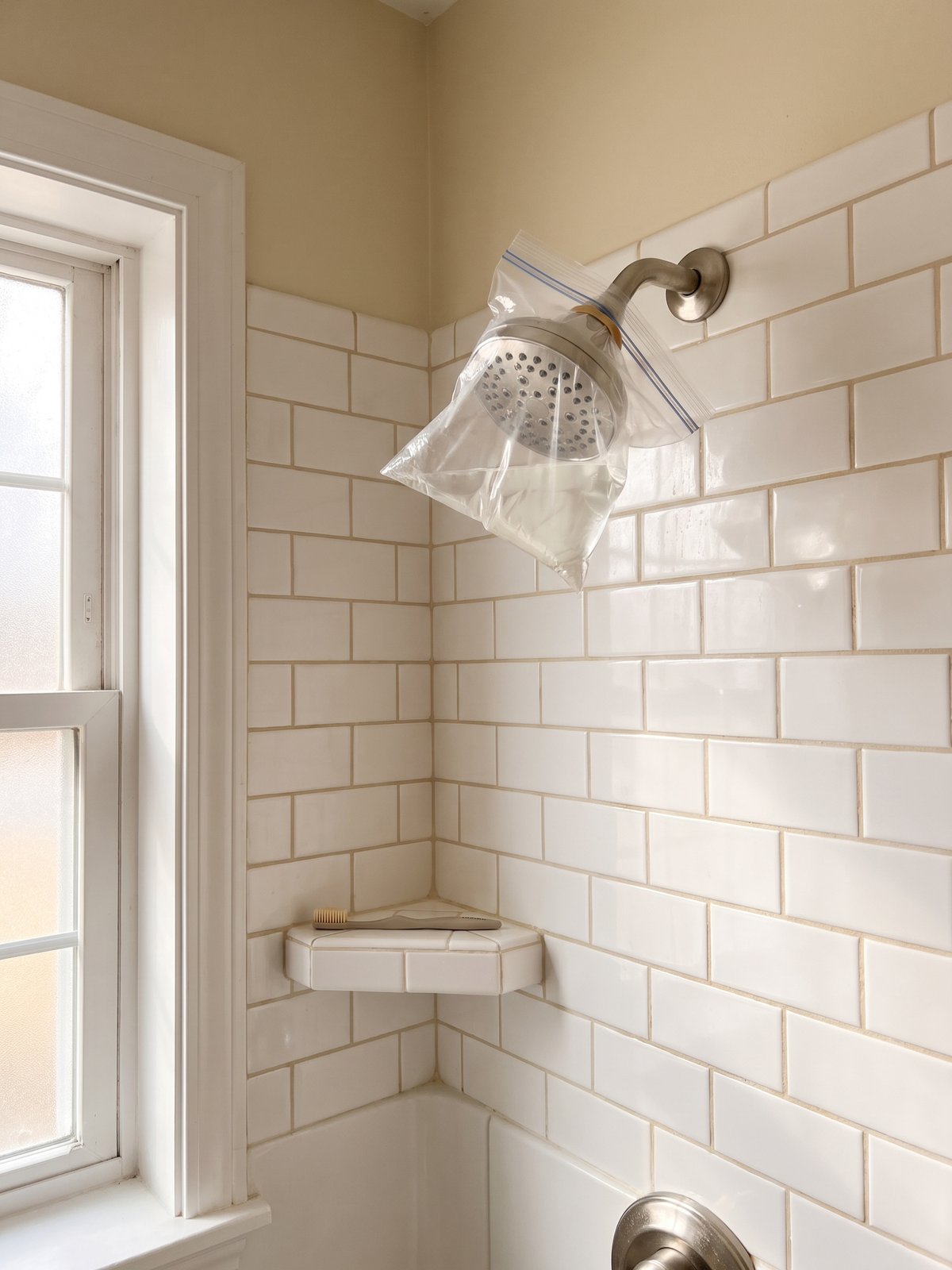
What works Fill a zip bag with white vinegar, slip it over the shower head so the nozzles sit in it, and hold it on with a rubber band. Soak, scrub the nozzles with a soft toothbrush, then run hot water to rinse.
Shower heads come in shiny chrome and in other finishes like brushed nickel, black or bronze. PlumbingSupply.com says chrome stands up to straight table vinegar with no problems. Any other finish gets a small test first, which is Step 1.
Dip a cotton swab in vinegar and hold it on a small hidden spot, like the back of the head, for up to 30 minutes. PlumbingSupply.com suggests this test for every finish except chrome. If the finish dulls, spots or changes color, stop here and skip to the soap tip in the next section.
What it looks like: a passing test leaves the spot looking just like the rest of the head once you wipe it dry.
Some shower heads, like Delta’s Touch-Clean models, are made so you can rub the spray holes with a finger. Delta says that rub loosens and wipes away residue, so do it first if yours is that kind.
For chrome, pour about 12 ounces of distilled white vinegar (a cup and a half) into a gallon zip bag, which is what American Standard suggests. For any other finish that passed the test, mix 1 cup of vinegar with 1 cup of water, the half and half mix Delta uses.
Lift the bag up over the shower head so every nozzle sits in the liquid. Wrap a rubber band around the top of the bag and the shower arm until it holds. If the nozzles poke above the liquid, add a little more.
What it looks like: the bag hangs full and snug, with the face of the head under the vinegar.
For chrome, leave it at least 1 hour, or overnight for heavy crust (American Standard). For other finishes, leave it 30 minutes (Delta), then check it and soak again only if you need to.
Take the bag off and pour the vinegar down the drain. Gently scrub the face of the head with a soft old toothbrush or a soft cloth, as Delta and American Standard both suggest.
What it looks like: the softened buildup wipes away from the spray holes.
Turn on the hot water and let it run 5 to 10 minutes to flush out the vinegar, as American Standard suggests. Then dry the outside with a soft cloth.
What it looks like: a full, even spray with no sideways jets.
Most shower heads come back to life with a soak or two. If yours does not, one of these is usually why.
We may earn a small fee from these links. It never changes the picks or your price.
Good & Gather was $0.99 for 16 ounces and $3.39 for 64 ounces at Target.com on 11/7/2026. One soak takes about 12 ounces.
up&up Size 19 rubber bands were $1.29 at Target.com on 11/7/2026.
up&up gallon storage bags ran $1.99 to $3.99 for a 40 count at Target.com on 11/7/2026.
More picks: Cleaning products you should never mix
The free Kitchen and Laundry Rescue Guide has the never-mix chart and the Poison Help number in big print, ready to tape inside your cabinet door.

That white crust is minerals. Hard water carries dissolved calcium and magnesium, and Delta explains that the deposits form when water dries on the shower head. Each shower leaves a few drops in the holes, and each drop leaves a little rock behind.
Vinegar is an acid, and acid dissolves that kind of mineral crust. It is the same reason vinegar works on the white film inside a tea kettle. Delta says vinegar’s acidity helps dissolve the deposits but is not harsh enough to hurt the finish or the parts inside.
The bag just gives the vinegar time. A quick spray would run right off, but a soak keeps the acid on the crust long enough to soften it, and then the toothbrush lifts it out.
Now think about your morning. Half the holes spray straight at the wall while the other half dribble, and you start the day already annoyed. A shower head that sprays right makes every morning a little better.
A word from Denise
So tie that bag on whenever the spray starts to weaken, and wipe the head dry after you shower.
For chrome, American Standard says at least an hour, or overnight for a deep clean. For other finishes, Delta uses half vinegar and half water for 30 minutes, then repeats if needed.
PlumbingSupply.com says chrome handles straight vinegar fine. For brushed nickel, black, bronze or any other finish, test a cotton swab of vinegar on a hidden spot for up to 30 minutes first.
There may be a clogged screen inside the nut, and that means taking the head off. Delta says not to use pliers or a wrench when you put it back.
Delta suggests wiping the water drops off the shower head with a soft cloth after each use. That way they cannot dry into new crust.
I’m Denise, and I explain home fixes the way a friend would at your kitchen table. Every tip I share is written from the sources listed on its page and checked against them before it goes up.
Sources opened and checked on November 7, 2026.
Every claim on this page, the source behind it and what the check found. Kept open for anyone who wants to look under the hood.
| Claim | Source | What the check found |
|---|---|---|
| Chrome stands up to straight vinegar | Source 3 (rechecked November 7) | Matches the source. |
| Other finishes: cotton swab test on a hidden spot up to 30 minutes | Source 3 (rechecked November 7) | Matches the source. |
| Rubbing the spray holes loosens and wipes away residue (Touch-Clean heads) | Source 1 (rechecked November 7; Delta says this of Touch-Clean spray holes, so the step is limited to heads made for it) | Matches the source. |
| About 12 oz vinegar in a resealable bag, rubber band on the arm | Source 2 (rechecked November 7) | Matches the source. “A cup and a half” is a unit conversion (12 fl oz = 1.5 cups) |
| Chrome soak at least 1 hour, overnight for heavy crust | Source 2 (rechecked November 7) | Matches the source. |
| Other finishes: 1 cup vinegar plus 1 cup water, 30 minutes, repeat | Source 1 (rechecked November 7) | Matches the source (Delta’s mix for its heads, applied to finishes that pass the swab test). |
| Soft toothbrush or soft cloth on the face | Sources 1 and 2 | Matches the source. |
| Run hot water 5 to 10 minutes after | Source 2 (rechecked November 7) | Matches the source. |
| Failed test: mild soap, warm rinse, clean soft cloth | Source 4 (rechecked November 7; Moen Nebia care) | Matches the source (text names the maker and model). |
| Gasket and screen inside the nut; no pliers or wrench when reinstalling | Source 1 (rechecked November 7) | Matches the source. |
| Avoid bleach, harsh cleaners, hydrochloric, hydrofluoric or phosphoric acid; abrasives could void warranty | Source 1 (rechecked November 7) | Matches the source. |
| Some lime and rust toilet cleaners carry those acids; Lysol Lime & Rust lists hydrochloric acid | Source 8 (opened November 7) | Matches the source (trimmed from “many” to “some” plus the named label). |
| Wipe drops off after each use | Source 1 | Matches the source. |
| Deposits form when water evaporates; acidity dissolves them but is not harsh enough to damage | Source 1 (rechecked November 7) | Matches the source. |
| Hard water has calcium and magnesium | Source 5 | Matches the source. |
| Vinegar works on kettle crust | Source 6 (rechecked November 7: “excellent cleaner for showers or kettles”) | Matches the source. |
| Vinegar is an acid; never mix bleach with acids | Source 7 | Matches the source (official). |
| Poison Help line, 1-800-222-1222; free and confidential, 24 hours a day, 7 days a week | Source 9 | Matches the source (HRSA Calling Poison Help page; one wording site-wide, November 7). |
| Prices: vinegar $0.99 / $3.39; rubber bands $1.29; gallon bags $1.99 to $3.99 | Source 10, read November 7, 2026 | Matches the source (dated, Target.com online). |
| Left out: step stool tips, a set monthly soak schedule, a bubbling cue during the soak | No source found | Left out on purpose |
| Left out: citric acid method; American Standard’s mildew and bacteria line | No amounts; germ claim not allowed | Left out on purpose |