A word from Denise
So pick a day that comes around every month, like the first Saturday, and give it a soak while you clean the rest of the kitchen. A filter cleaned often is a much easier job than one that has waited a year.
Every tip here is checked against the sources listed at the bottom.
 By Denise. Checked on November 7, 2026 against the sources at the bottom of this page.
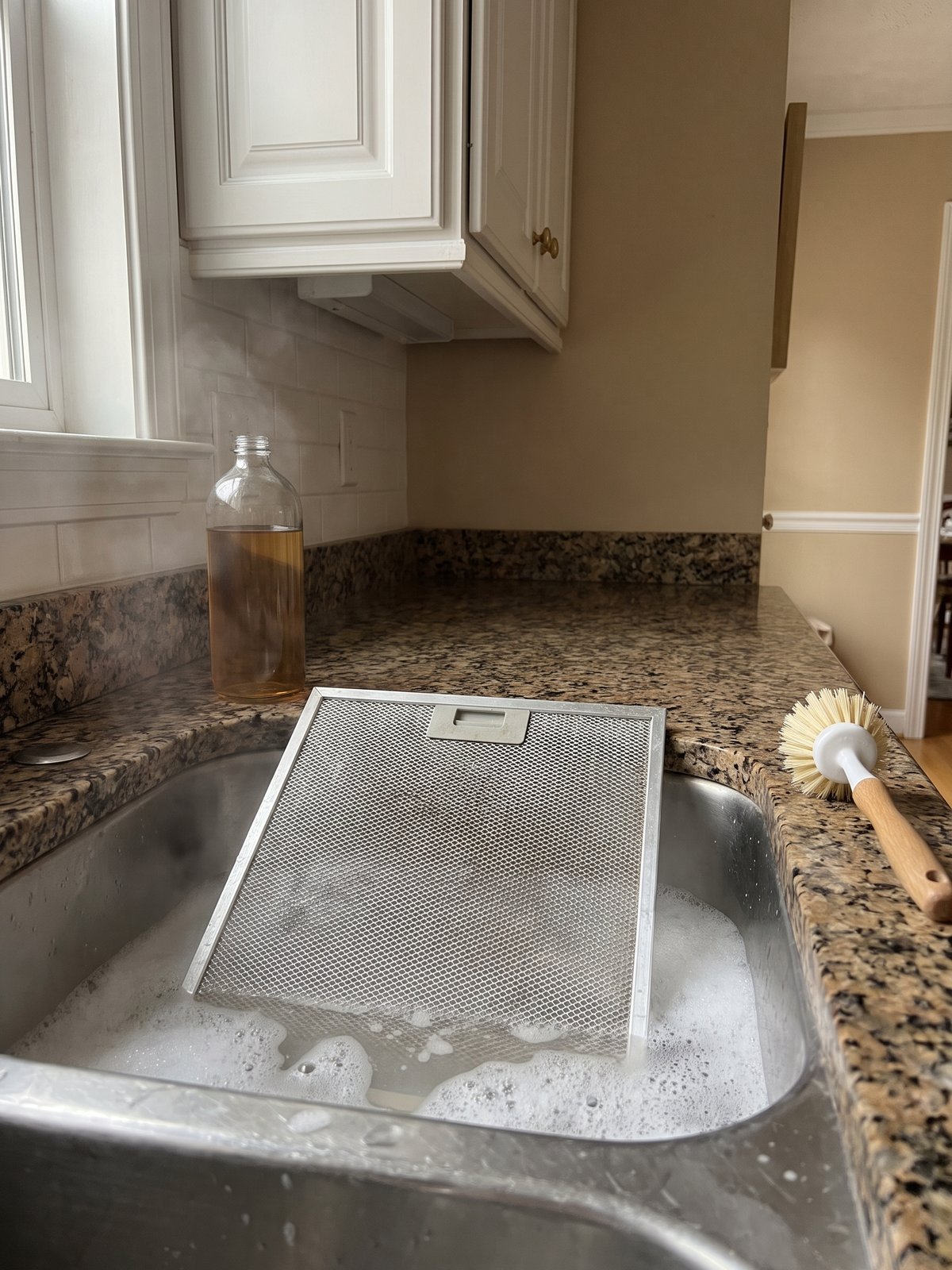
What works Turn off the hood and let it cool. Pull out the metal filter and soak it in hot water with dish soap for 15 to 20 minutes on each side. Brush it gently, rinse it, dry it and put it back.
Switch off the fan and light and give the hood time to cool. GE’s hood manual goes a step further: it says to make sure the circuit breaker is off and all surfaces are cool before cleaning any part of the vent hood.
Most filters have a tab or a latch. GE’s design, for example, has a filter lock you pull down to release it. Lower the filter carefully and keep the greasy side up until it reaches the sink.
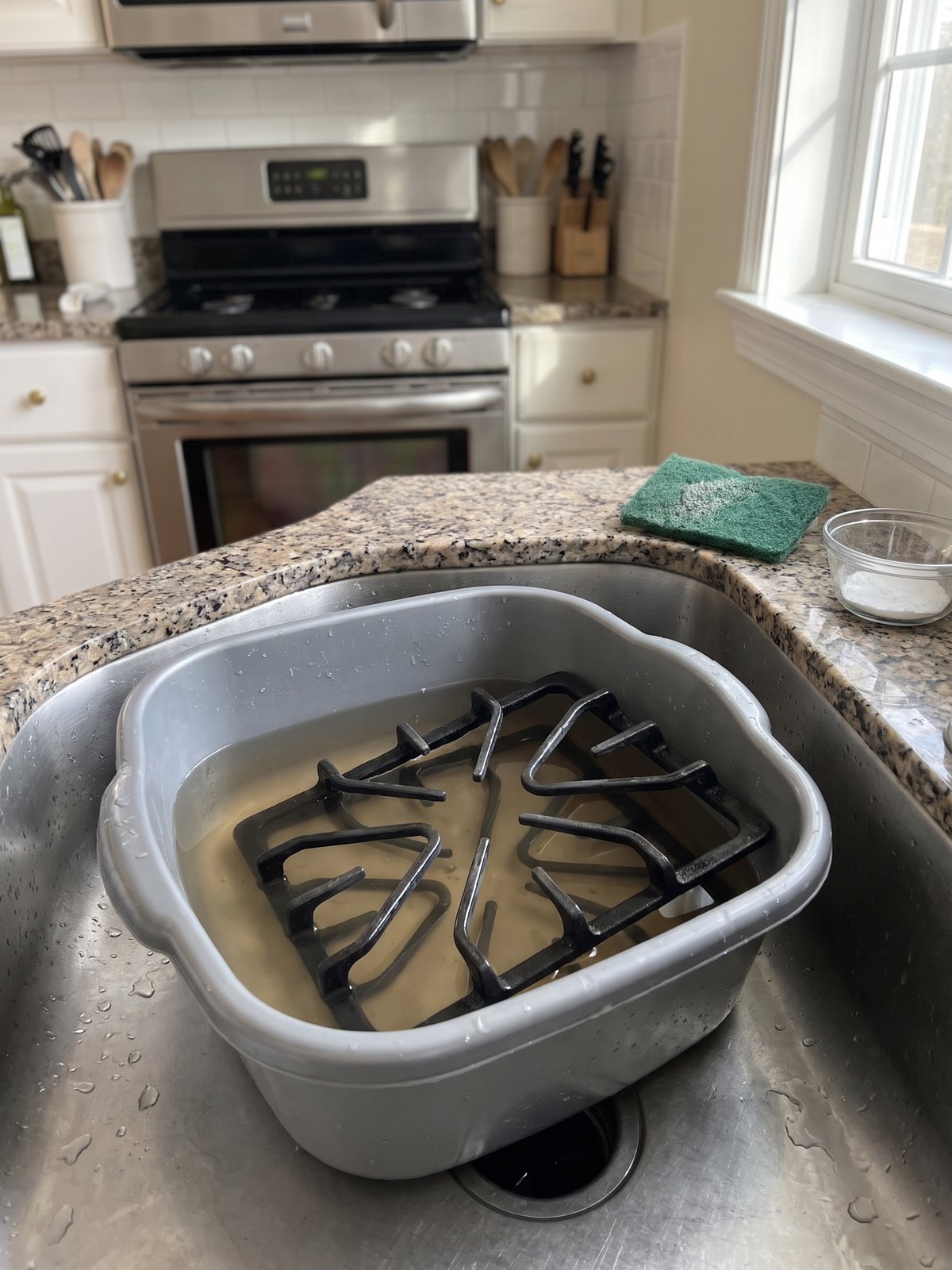
Plug the sink and fill it with hot tap water, deep enough to cover the filter. Squeeze in a good squirt of dish soap and swish it until it suds.
Lay the filter flat in the water. Broan, a hood maker, says to soak for 15 to 20 minutes per side for best results. Then flip it and soak the other side.
Swish the filter back and forth in the water, then brush the mesh with a soft brush or a non-scratch pad. GE’s manual says not to use abrasive cleansers on the filter, so let the soak do the hard work.
Rinse the filter in clean water until no suds are left, as GE directs. Shake off the water and pat it dry with a towel.
Slide the filter back into its slots and make sure the latch closes. GE says the filter must always be in place when the hood is in use, because it is the part that traps the grease.
Many metal filters can go in the dishwasher. GE’s hood manuals say their metal grease filters can be washed in the dishwasher, and Broan says some of theirs can too, so check your owner’s manual first.
GE notes that some discoloration may happen in the dishwasher. Broan says to use a non-phosphate detergent, because phosphate detergents can discolor filters, and that the discoloration does not affect how the filter works.
GE’s manuals range from once a month to every 6 months, “or as needed.” If the filter looks dark and sticky, it is time.
Old grease can take more than one round. Here is what to try.
We may earn a small fee from these links. It never changes the picks or your price.
Made to grab grease, and it is the whole soak. The 14.7 oz Dawn Ultra Clean Scent bottle was $2.89 to $3.99 at Target.com on 11/6/2026.
They scrub the mesh without the scratch of steel wool. Scotch-Brite Zero Scratch Scour Pads, 4 count, were $3.99 at Target.com on 11/6/2026.
For the last stubborn spots. $1.79 at Target.com on 11/6/2026.
The free Kitchen and Laundry Rescue Guide has the hood filter soak, which cleaner goes on which metal, and the never-mix chart, ready to print.

Here is what is going on up there. When you cook, grease rides up with the steam, and GE describes the metal filter as the part that traps it on its way up.
Heat changes that grease over time. Lodge, the cast iron maker, explains that oil heated hot enough changes from a wet liquid into a slick, hardened surface. That is why an old filter can feel tacky instead of oily.
Hot water softens that layer, and dish soap does the lifting. The American Cleaning Institute explains that one end of a soap molecule loves water and the other loves oil and grease, so the grease gets pulled off the metal and carried away in the water.
Most of us never think about that filter until we look up one day and see it gone dark and sticky. It sits just above eye level, so it is easy to miss.
A word from Denise
So pick a day that comes around every month, like the first Saturday, and give it a soak while you clean the rest of the kitchen. A filter cleaned often is a much easier job than one that has waited a year.
Often, yes, if it is a metal filter and your manual allows it. GE says some discoloration may happen, and Broan says discoloration does not affect how a filter works. Never put a charcoal filter in the dishwasher.
Use one or the other, not both together. Mixed, they react into water, a salt and carbon dioxide (the fizz), and a chemist writing in The Conversation advises using either one by itself. Dish soap and hot water do most of the work anyway.
Usually it is the cleaner. GE says ammonia darkens the metal, Arm & Hammer says washing soda is not for aluminum, and Broan says phosphate dishwasher detergent can discolor filters.
GE’s manuals say anywhere from once a month to every 6 months, or as needed.
I’m Denise, and I explain home fixes the way a friend would at your kitchen table. Every tip I share is written from the sources listed on its page and checked against them before it goes up.
Sources opened and checked on November 7, 2026.
Every claim on this page, the source behind it and what the check found. Kept open for anyone who wants to look under the hood.
| Claim | Source | What the check found |
|---|---|---|
| Breaker off and all surfaces cool before cleaning any part of the vent hood | Source 1 | Matches the source (maker; rechecked November 7). |
| Charcoal filter cannot be cleaned, must be replaced; do not rinse or dishwash; replace every 6 to 12 months or if noticeably dirty | Source 1 | Matches the source (maker; rechecked November 7). |
| Soak 15 to 20 minutes per side | Source 3 | Matches the source (maker; rechecked November 7). Broan says warm water with mild detergent; the page uses hot soapy water per GE (Sources 1 and 2) |
| Swish in hot soapy water, rinse in clean water; no abrasive cleansers | Sources 1 and 2 | Matches the source (maker; rechecked November 7). |
| Metal filters dishwasher safe on GE models; some Broan filters; check manual | Sources 1, 2, 3 | Matches the source (maker). |
| GE: some discoloration may occur in the dishwasher. Broan: non-phosphate detergent; phosphate can discolor; discoloration does not affect performance | Sources 1 and 3 | Matches the source (maker; wording corrected 11/7 so each claim is credited to the maker that makes it). |
| Clean every month to every 6 months, or as needed | Sources 2 (monthly) and 1 (6 months) | Matches the source (maker; two models differ, both shown). |
| Metal filters trap grease; filter must always be in place when the hood is in use | Source 1 | Matches the source (maker; rechecked November 7). |
| Ammonia darkens metal filters | Source 2 | Matches the source (maker; rechecked November 7). |
| No washing soda on aluminum; it can darken it | Sources 4 and 5 (do not use on aluminum) | Matches the source. For the warning (rechecked November 7); the darkening is how the warning is explained, not a quote from these pages |
| Washing soda 1/2 cup per gallon of warm water helps keep range hoods grease free | Source 5 | Matches the source (maker; rechecked November 7).; applied to stainless filters only |
| Arm & Hammer gives baking soda methods for aluminum pans | Source 6 | Matches the source (maker; rechecked November 7). |
| Heated oil changes from a wet liquid into a slick, hardened surface | Source 7 | Matches the source (maker explainer; rechecked November 7). |
| One end of a surfactant is attracted to water, the other to oil and grease | Source 8 | Matches the source (rechecked November 7). |
| Bleach plus ammonia makes toxic chloramine gases | Source 9 | Matches the source (official; rechecked November 7). |
| Gloves; flush eyes with water if washing soda gets in | Source 4 | Matches the source (maker; rechecked November 7). |
| Poison Help line, 1-800-222-1222; free and confidential, 24 hours a day, 7 days a week | Source 10 | Matches the source (HRSA Calling Poison Help page; one wording site-wide, November 7). |
| Baking soda and vinegar form water, sodium acetate and carbon dioxide; use either one by itself | Source 11 | Matches the source (opened November 7). |
| Prices: Dawn Ultra 14.7 oz $2.89 to $3.99; Scotch-Brite Zero Scratch Scour Pads 4 ct $3.99; baking soda 1 lb $1.79 | Source 12, opened November 6, 2026 | Matches the source (dated, Target.com online). |