A word from Denise
So mix the grease spray for the stovetop, use plain dish soap for the dishes, and buy the store spray only if you truly love it. Either way, label every bottle the minute you fill it.
Every tip here is checked against the sources listed at the bottom.
 By Denise. Checked on November 7, 2026 against the sources at the bottom of this page.
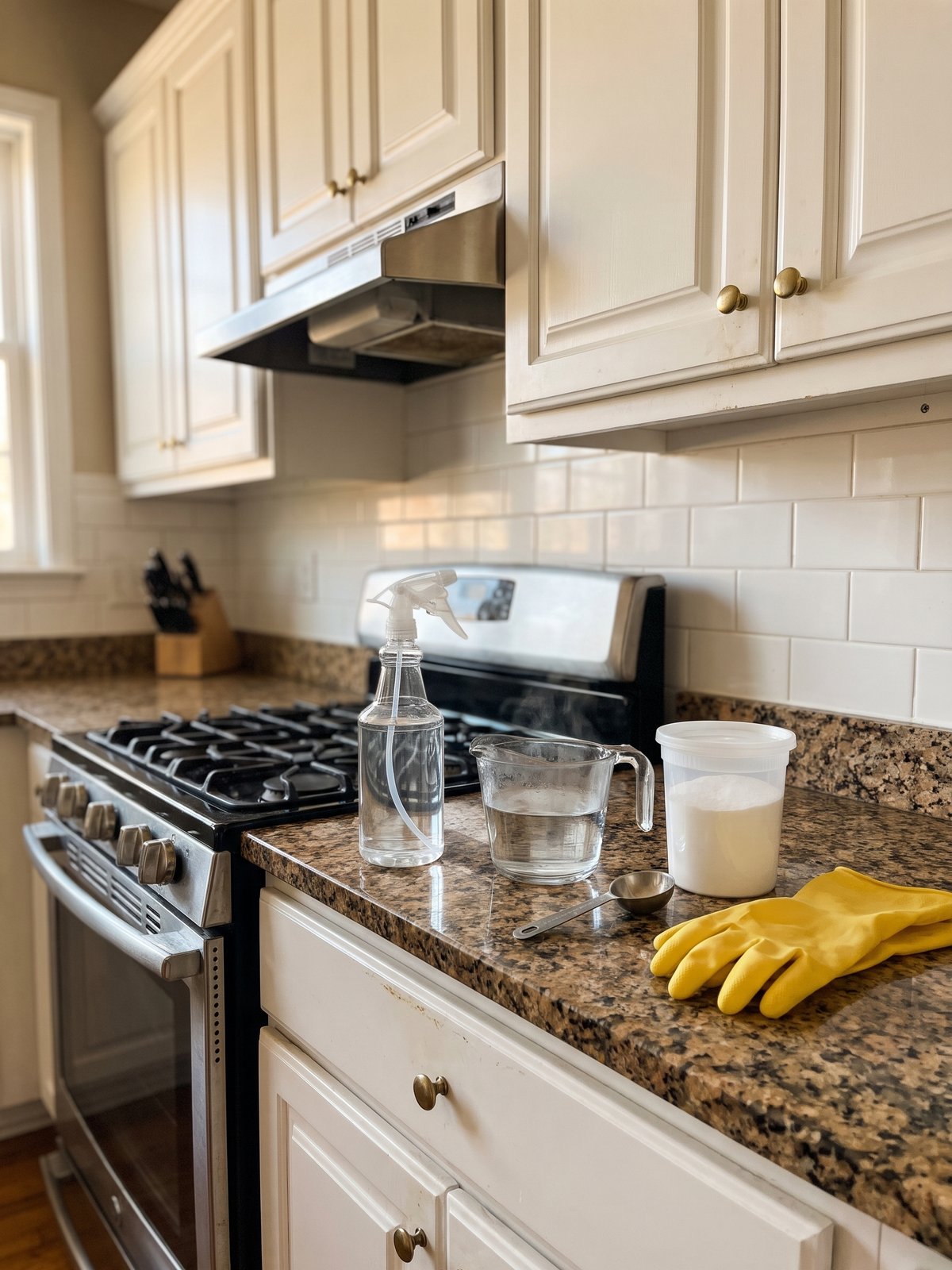
What works For grease on stovetops, oven doors and broiler pans, stir 1 tablespoon of washing soda into 2 cups of warm water in a new spray bottle. That is the box label’s own strength of half a cup per gallon of warm water, scaled down. Wear gloves, then spray, wipe and rinse. Plates and glasses just need dish soap.
It helps to know what this page leaves out, and why.
Put on rubber gloves. Write “Grease spray: washing soda and water. Gloves on. Not for aluminum.” and today’s date on a new spray bottle. University of Georgia Extension says to label homemade mixes with what is in them and the date.
Add 2 cups of warm water to the bottle. The washing soda label calls for warm water.
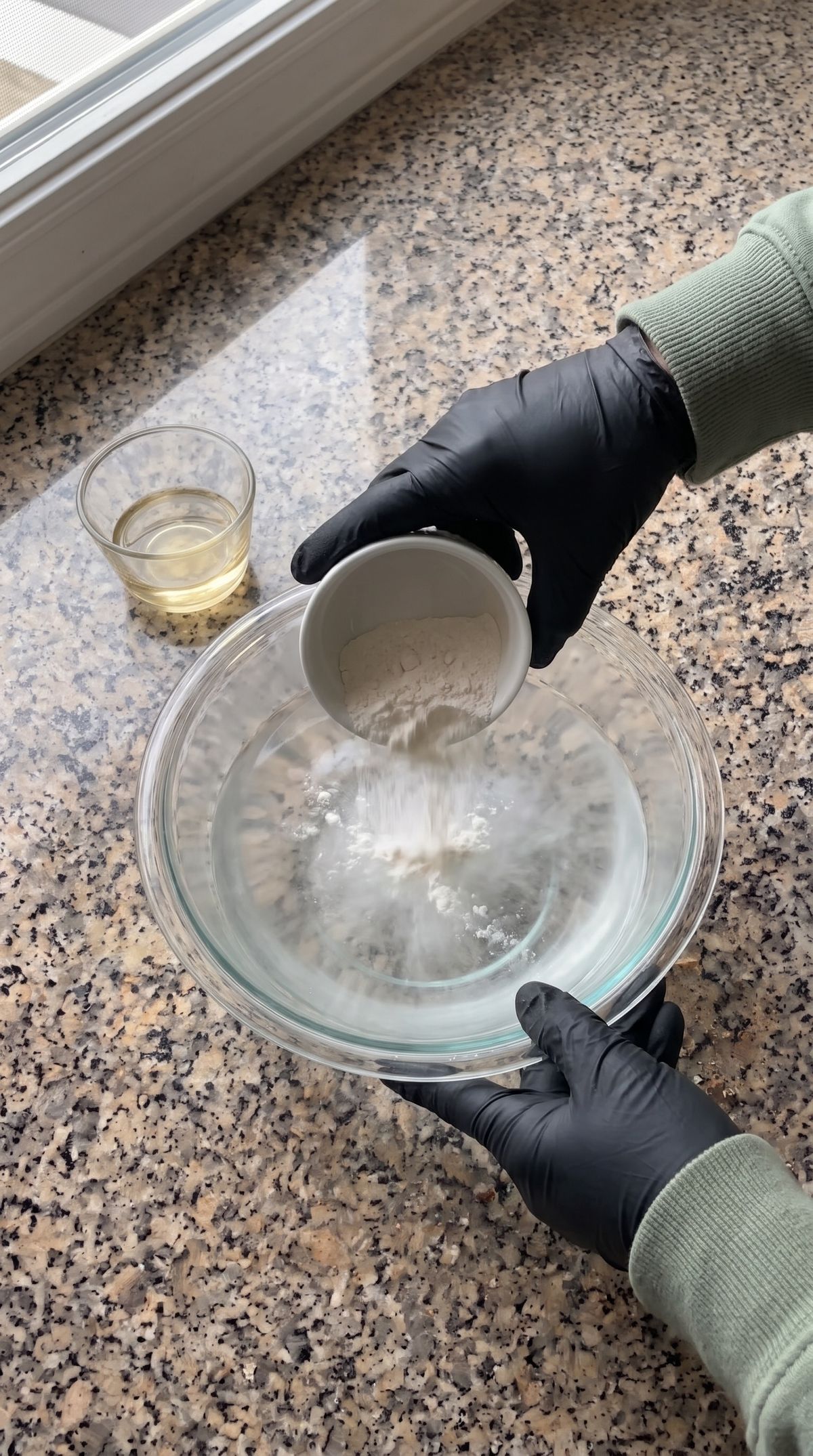
Add 1 tablespoon of washing soda, screw the sprayer on and swirl until no powder is left at the bottom. Here is the math: the label says half a cup per gallon, half a cup is 8 tablespoons, and a gallon is 16 cups. So every 2 cups of water gets 1 tablespoon.
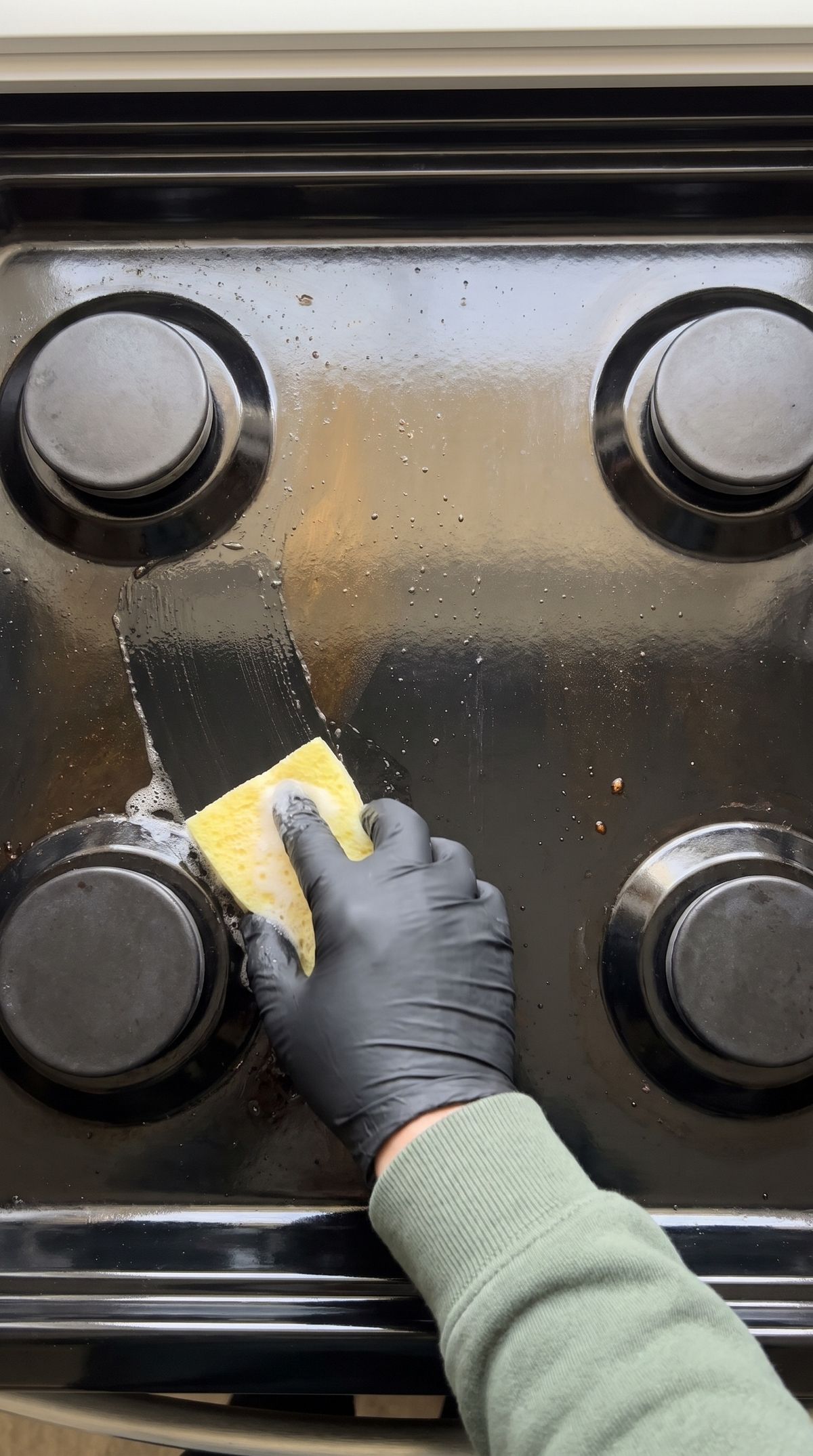
Make sure the burners are off and cool. Spray the greasy spot until it is wet, then wipe it with a non-scratch sponge.
Wipe the surface again with a cloth and plain water until no residue is left. The washing soda label says to rinse thoroughly after you wash a kitchen surface, with rubber gloves on.
A homemade spray has limits. Here is what to do when you run into one.
We may earn a small fee from these links. It never changes the picks or your price.
The only ingredient besides water. Look in the laundry aisle. $5.49 at Target.com on 11/7/2026.
Big enough for the 2 cup batch. $2.99 at Target.com on 11/7/2026.
The label says to wear them. $3.39 at Target.com on 11/7/2026 ($3.89 for the latex free pair).
The free Kitchen and Laundry Rescue Guide has the never-mix chart and a one-page cabinet card showing what washing soda and four other basics are good for, and where they should never go.

Washing soda is sodium carbonate. The American Cleaning Institute calls it a fairly strong alkaline salt, and it also calls it a builder, meaning it helps the cleaning agents in soap keep working.
Those cleaning agents have a neat trick. The same group explains that every one has two ends: one end wants to be in water, and the other end avoids water and grabs onto oily dirt.
Picture a person with one hand on the grease and the other hand on the rinse water. When the water runs off, it carries the grease right along with it. Washing soda helps that hand hold on a little harder on a greasy stovetop.
It is easy to stand in the store holding a four dollar refill and think, “This is mostly water and soap, isn’t it?” You are partly right, but the store formula has a solvent your kitchen does not.
A word from Denise
So mix the grease spray for the stovetop, use plain dish soap for the dishes, and buy the store spray only if you truly love it. Either way, label every bottle the minute you fill it.
For greasy stovetops, oven doors and broiler pans, use 1 tablespoon of washing soda in 2 cups of warm water, scaled from the box label’s half a cup per gallon. Wear gloves and rinse after. For plates and glasses, plain dish soap and warm water are all you need.
No maker gives amounts for a soap and alcohol spray, so we do not print one. Rubbing alcohol is also flammable, and its label says to keep it away from fire, flame, heat and sparks.
No. Even the store-bought power spray’s label says it is not for use in dishwashers.
No. Vinegar is an acid, and it cancels out the washing soda, so you lose the strength of both.
I’m Denise, and I explain home fixes the way a friend would at your kitchen table. Every tip I share is written from the sources listed on its page and checked against them before it goes up.
Sources opened and checked on November 7, 2026.
Every claim on this page, the source behind it and what the check found. Kept open for anyone who wants to look under the hood.
| Claim | Source | What the check found |
|---|---|---|
| Grease spray: 1 Tbsp washing soda in 2 cups warm water, scaled from the label’s 1/2 cup per gallon of warm water (8 Tbsp per 16 cups) | Sources 1 and 2; arithmetic | Matches the source (label ratio, scaled; no other amounts on the page). |
| Maker lists ovens, range tops and broiler pans for this solution | Source 1 | Matches the source (maker). |
| Kitchen surfaces: wash, rinse thoroughly, rubber gloves | Source 2 | Matches the source (label). |
| Store spray label lists alcohol, surfactants and dipropylene glycol butyl ether; “Not for use in dishwashers” | Source 3 | Matches the source (label). |
| No maker prints amounts for a dish soap, rubbing alcohol and water spray | Search on November 7, 2026 found only blogs and retailer copies; no soap or alcohol maker page | Matches the source (absence). The recipe was cut for this reason |
| New containers, never ones that held food, drinks or chemicals; label with ingredients and date; no more than a month’s supply; away from children | Source 7 | Matches the source (university extension). |
| Rubbing alcohol is flammable; keep away from fire, flame, heat, spark | Source 4 | Matches the source (label). |
| Surfactant has two ends, one wants water, one does not | Source 5 | Matches the source. |
| Sodium carbonate a fairly strong alkaline salt; a builder enhances or maintains the cleaning efficiency of the surfactant | Source 6 | Matches the source. |
| Dish soaps necessary for cutting grease | Source 9 | Matches the source (university extension). |
| Washing soda: not on aluminum, no-wax floors, treated wood; eye irritant; harmful if swallowed; gloves; eyes 15 min | Sources 1 and 2 | Matches the source (maker and label). |
| Nonstick: no metal tools or scrubbing pads; nylon brush or non-scratch sponge | Source 8 | Matches the source (maker). No maker page on washing soda and nonstick was found, so the page says to skip it |
| Baked-on grease needs a paste and a 30 minute wait | The Super Soap page; label “let stand for 30 minutes” for pots and pans (Source 2) | Matches the source. |
| Vinegar cancels washing soda; acids are incompatible | Source 11 | Matches the source. |
| Bleach plus rubbing alcohol forms chloroform: dizziness, nausea, headaches, loss of consciousness | Source 10 | Matches the source (official). |
| Prices: washing soda 55 oz $5.49; up&up spray bottle 32 oz $2.99; up&up latex gloves $3.39 (latex free $3.89); Dawn Platinum Powerwash refill 16 oz $3.99 | Source 13, read November 7, 2026 | Matches the source. Dated, Target.com online. Walmart links kept with no price |
| Poison Help line, 1-800-222-1222; free and confidential, 24 hours a day, 7 days a week | Source 12 | Matches the source (HRSA Calling Poison Help page; one wording site-wide, November 7). |