A word from Denise
It almost never is. Let it cool, reach for the cream and the scraper, and take your time. Then keep one small habit: lift your pots instead of sliding them, and those gray marks will not keep coming back.
Every tip here is checked against the sources listed at the bottom.
 By Denise. Checked on November 7, 2026 against the sources at the bottom of this page.
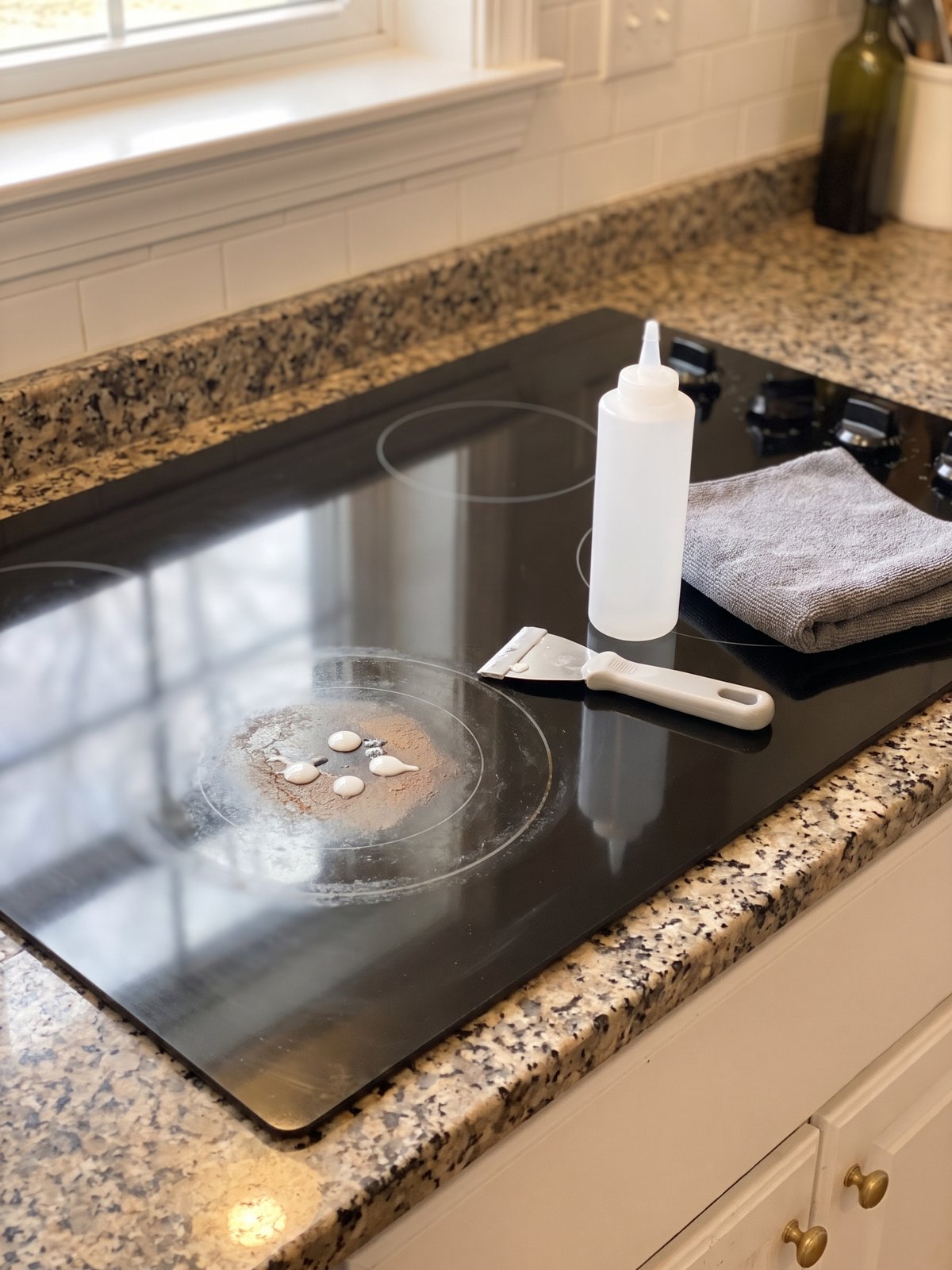
What works Let the cooktop cool, then rub a few dime-size drops of cooktop cream into the burnt spots. Scrape anything stuck on with a razor scraper held at about a 45 degree angle, with a little cream under the blade. Let the cream dry to a white haze, then buff it off with a dry cloth.
Most messes can wait until the glass is cool. Sugary spills and melted plastic cannot, because GE Appliances warns they can cause permanent damage.
GE says to deal with those right away. Turn off the burners and move the hot pans. Put on an oven mitt, and use the razor scraper to push the spill over to a cool part of the cooktop. Then wipe it up with paper towels, and leave whatever is left until the glass cools down.
Do not cook on that burner again until every bit of the spill is gone.
Make sure every burner is off and the glass is cool to the touch. GE and Weiman both say to start on a cool surface. Whirlpool says scraping goes best while the glass is still warm but not hot, with an oven mitt on. If you are not sure, wait until it is cool.
Shake the bottle well. Weiman’s label says to test it on a small, hidden area first. Then squeeze a few dime-size drops onto the burnt spots, as Whirlpool directs, and rub them in with a cooktop scrubbing pad or a paper towel.
Hold the razor scraper at about a 45 degree angle to the glass, the way GE and Whirlpool both describe. GE says to keep a little cream on the spot as you scrape. Use only a scraper made for glass cooktops.
Rub on a little more cream and work the spot with the pad. Whirlpool says to repeat the cream, scrape and polish steps as many times as it takes for stubborn or burned-on stains.
Let the cream dry to a white haze, which is Whirlpool’s cue to move on. Then buff with a clean, dry cloth or paper towel until the haze is gone. GE suggests polishing the whole surface this way once the spots are clean, for extra protection.
What it looks like when it worked: a clear, glossy cooktop with no white haze left on it.
Run your fingers over the glass. GE says not to heat the cooktop until all of the cream is wiped off.
Some marks are not dirt at all. Here is how to tell what you are looking at.
We may earn a small fee from these links. It never changes the picks or your price.
GE names Weiman’s cooktop cleaner as an approved choice. $4.99 on sale (regularly $5.29) at Target.com on 11/7/2026.
For buffing off the haze. A 3 pack of up&up microfiber cloths was $6.99 at Target.com on 11/7/2026.
This is the tool both GE and Whirlpool describe for burnt-on food. Look for one sold for cooktops, with a cover for the blade.
The free Kitchen and Laundry Rescue Guide has these cooktop steps, the sugar spill rule and the never-mix chart, ready to print.

A glass cooktop looks tough, but the wrong scrubber can leave marks you see every time the light hits it. That is why Whirlpool keeps steel wool and gritty powders off its glass, and why the makers point you to a cream made for the job.
Cooktop cream loosens what is burnt on without scratching, as Weiman puts it. The thin layer you buff off at the end is part of the job, too. Weiman says its cream cleans, shines and protects in one step, and GE calls that final polish extra protection.
The razor scraper works because it slides flat along the glass and gets under the crust, so you never have to scrub hard.
Sugar is the one to watch, because GE warns it can do permanent damage. That is why it gets moved while the glass is hot, with a mitt on, and everything else waits until the glass is cool.
Every one of us has turned around for one minute and come back to a pot boiling over onto a nice cooktop. It feels like the whole thing is ruined.
A word from Denise
It almost never is. Let it cool, reach for the cream and the scraper, and take your time. Then keep one small habit: lift your pots instead of sliding them, and those gray marks will not keep coming back.
Let it cool, rub a few drops of cooktop cream into the spot, then scrape at about a 45 degree angle with a razor scraper made for cooktops. Repeat as needed, then buff off the haze with a dry cloth.
Yes, if it is a scraper made for glass cooktops. GE and Whirlpool both tell you to use one at about a 45 degree angle, and GE says to keep a little cream on the spot while you scrape.
Whirlpool says not to use abrasive powder cleansers or ammonia on its glass cooktops, and some glass cleaners contain ammonia. GE says other cleaners can damage the glass, so a cream made for glass cooktops is the safe choice.
That is usually leftover cream. Whirlpool says to let it dry to a white haze and then buff it off with a clean, dry cloth. Keep buffing until the glass is clear.
I’m Denise, and I explain home fixes the way a friend would at your kitchen table. Every tip I share is written from the sources listed on its page and checked against them before it goes up.
Sources opened and checked on November 7, 2026.
Every claim on this page, the source behind it and what the check found. Kept open for anyone who wants to look under the hood.
| Claim | Source | What the check found |
|---|---|---|
| Start on a cool surface | Sources 1, 2, 3 | Matches the source (makers; rechecked). |
| Whirlpool: scrape while warm but not hot, wear an oven mitt | Source 2 | Matches the source (rechecked; differs from GE, so the copy says cool if unsure). |
| A few dime-size drops of cooktop cleaner on the spot | Source 2 | Matches the source (rechecked). |
| Razor scraper at about 45 degrees with cream kept on the residue | Sources 1 and 2 | Matches the source (rechecked). |
| Repeat steps for stubborn or burned-on stains | Source 2 | Matches the source (rechecked). |
| Let cream dry to a white haze, then polish with a clean dry cloth or paper towel | Source 2; Source 3 (buff) | Matches the source (rechecked). |
| Do not heat the cooktop until all cream is removed | Source 1 | Matches the source (rechecked). |
| Sugary spills and melted plastic: units off, remove hot pans, oven mitt, scrape to a cool area, paper towels, leave the rest until cool, do not use units until removed | Source 1 | Matches the source (rechecked). |
| Pitting or indentation means the glass must be replaced | Source 1 | Matches the source (rechecked). |
| Sugary spills and melted plastic can cause permanent damage | Source 1 (section heading) | Matches the source (wording matches GE: “permanent damage”). |
| Sliding pans leaves metal marks; cream, cleaning pad or razor scraper removes them | Source 1 | Matches the source (rechecked). |
| Pot with a thin aluminum or copper overlay boiling dry leaves a black mark; remove before heating again or it can be permanent | Source 1 | Matches the source (rechecked). |
| Whirlpool: no steel wool, abrasive powder cleansers, chlorine bleach, rust remover or ammonia | Source 2 | Matches the source (rechecked). |
| GE: sponges or cleaners other than recommended can damage; Weiman’s or CeramaBryte approved | Source 1 | Matches the source (rechecked). |
| Some glass cleaners contain ammonia | Source 5 | Matches the source (“some”, as the source says). |
| Weiman label: test on a hidden area; keep out of reach of children and pets; avoid eyes; do not swallow; rinse eyes; if swallowed do not induce vomiting, call a physician | Source 4 | Matches the source (rechecked). |
| Weiman cream cleans, shines and protects; will not scratch | Source 3 | Matches the source (rechecked). |
| GE calls the final polish additional protection | Source 1 | Matches the source (rechecked). |
| Prices: Weiman 15 oz cream $4.99 (was $5.29); up&up microfiber 3 pack $6.99 | Source 7, opened November 7, 2026 | Matches the source (dated, Target.com online). No razor scraper or Walmart price shown (none read) |
| Poison Help line, 1-800-222-1222; free and confidential, 24 hours a day, 7 days a week | Source 6 | Matches the source (HRSA Calling Poison Help page; one wording site-wide, November 7). |
| Habit: lift pots instead of sliding them | Source 1 | Matches the source (GE’s own caution). |